
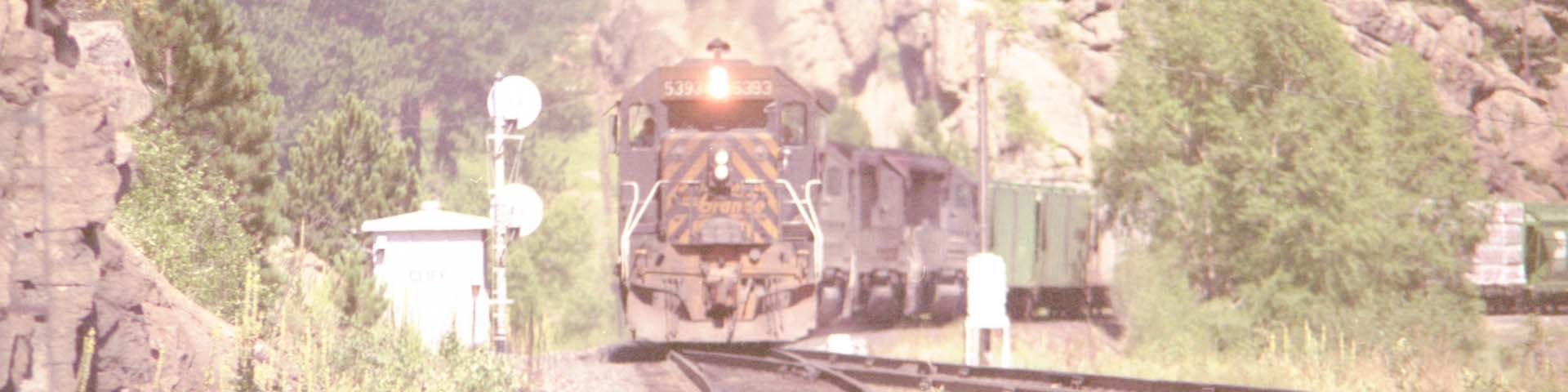

A Model Railroad for Many Seasons- Yet It’s Always Winter…
La Plata Division links menu:
** MAJOR RENOVATION IN PROGRESS **
Starting in October 2023 I began replacing the Big 10 and Tunnel 29 sections of the railroad with a brand-new concept. I’ve been detailing the saga over on the Facebook group. Basically, after a decade and more of operation I reached the conclusion that the grades and curvature were untenable. Additionally, the Tunnel 29 section was originally built long before I knew anything about serious model railroad operations, and the design frankly didn’t age well. So, it had to go. Ditto the Big 10 Curves, a favorite feature of mine and a difficult choice to destroy. It would only be worth it if it were replaced by something much better! I will post more as reconstruction progresses, but here are the highlights:
- Helix radius expanded to 30″ (up from 23″)
- Minimum mainline curvature also 30″ (up from ~24″)
- Grades carefully and consistently kept to 1.9%
- Complete elimination of all reverse curves
- Major new scene: South Draw, deep in the heart of the Tunnel District
- Major new scene: Plainview siding, with sufficient length to be useful. Includes a house track.
(What follows is the original text, to be adjusted later as necessary to describe new realities)
My model railroad is based on the Moffat Road’s line between Denver and Winter Park. I operate multiple eras between say 1972 and the present day, depending on which suite of rolling stock I place on the layout. To represent such diverse history, I must roster equipment from the Rio Grande, Southern Pacific, Union Pacific, Burlington Northern, BNSF, and even some Santa Fe (plus a few lease units). And that’s just the motive power; rolling stock includes a typical (and prototypical) mix of cars that would be seen on the Moffat during the chosen period.
The idea is to capture the feel of the ascent from Denver to the continental divide. For the real railroad, ascending some 4,000 feet of elevation in about sixty miles is a real operational challenge. In my case, the distances are much smaller but the challenges are similar. For one thing, I don’t have automatic air brakes on my cars!
When I constructed the current version of the layout, I implemented a major change in design philosophy. Instead of a continuous loop, the layout is a point-to-point design with a reverse loop at one end. The mainline is single track with sidings, just like the real thing.
The layout occupies about half of my garage with a footprint roughly 18′ X 12′. In HO scale, it’s difficult to fit much railroad into a space this size, so I decided to double-deck much of the layout. Since I don’t have a warehouse to build it in, I chose to concentrate on a few selected scenes. Each is separated from the rest by some sort of view block, and arranged sequentially.
Also, given the dimensional restrictions and the scale, a considerable degree of compression is required to fit everything in. My compression ratio is roughly 4:1. I didn’t compromise on the ruling grade, which is 2% in places. Operations over several years revealed this to be untenable on 24″ curves, leading to a rebuilding project, described elsewhere, with minimum 30″ curvature.
On the subject of compression: I have taken quite a bit of “modeler’s license” with certain aspects of the scenes. For instance, Plainview siding has had everything between Rainbow Cut and Tunnel 2 lopped out. South Draw between tunnels 13 and 16 is actually only compressed at 2:1. And since I used the real contour map for the mountains, they’re only 50% as tall in comparison to the track, though still pretty huge.
Click Here to see the basic track plan. And here is the revision; this takes the place of the Big 10 and Pinecliffe areas.
Starting at the lower end, the route begins at North Yard in Denver. The south end of the yard leads to the Joint line connection (not modeled), and to Denver Union Station and its multiple depot tracks.
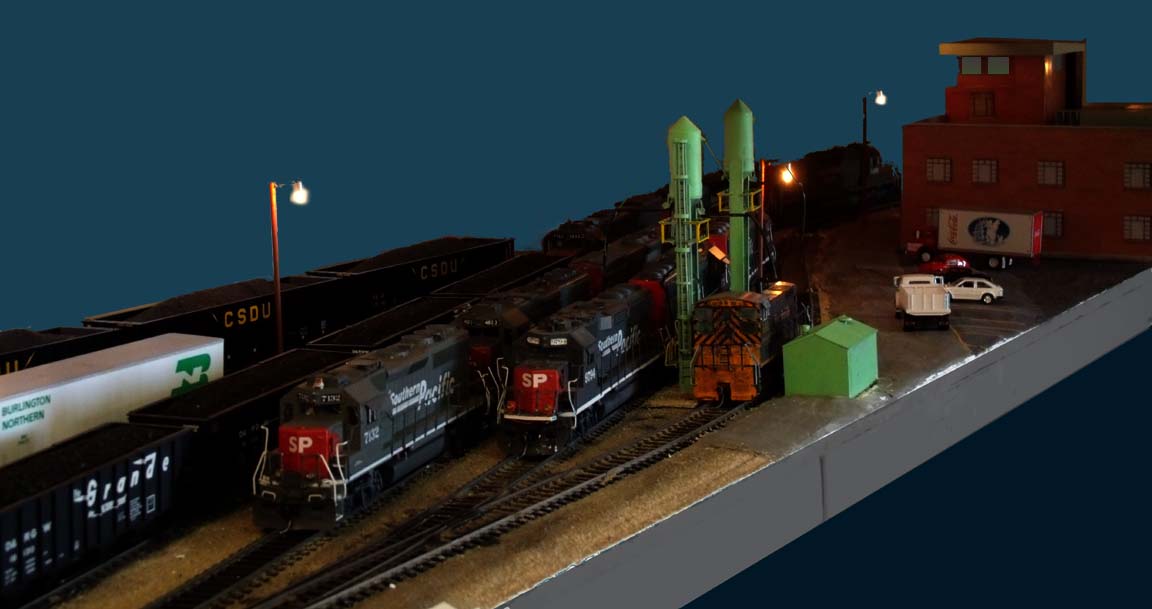 |
North Yard itself contains engine servicing tracks, bowl tracks, a piggyback track, and the Cargill elevator. The north end of the yard (RR west) leads to the westbound main line and Rocky siding. |
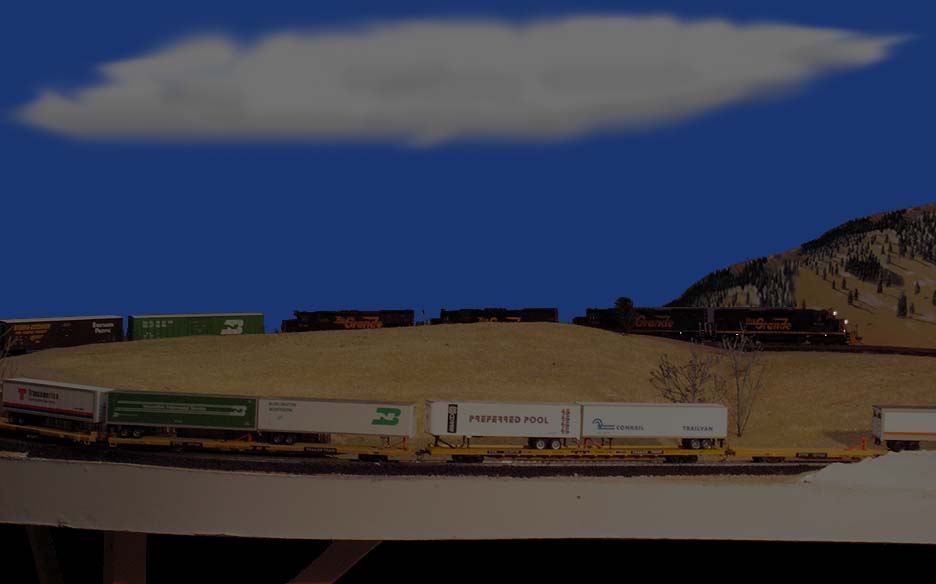 |
ORIGINAL CONSTRUCTION: Next are the Big 10 curves, which connect the lower level to the upper level. Clay siding is next, followed by tunnel 2. This forms a scene break. (Photo: westbound freight train rounds the Big 10 curve.) |
 |
ORIGINAL CONSTRUCTION: The next scene is in South Boulder Canyon, between tunnels 27 and 30. The scenery is vertical and the track’s curvature is tight, just like the real thing. Those who have visited the area will recognize the scenery. (Photo: westbound Amtrak No. 5 exiting tunnel 27 high above South Boulder creek.) |
| NEW CONSTRUCTION: The Tunnel District | |
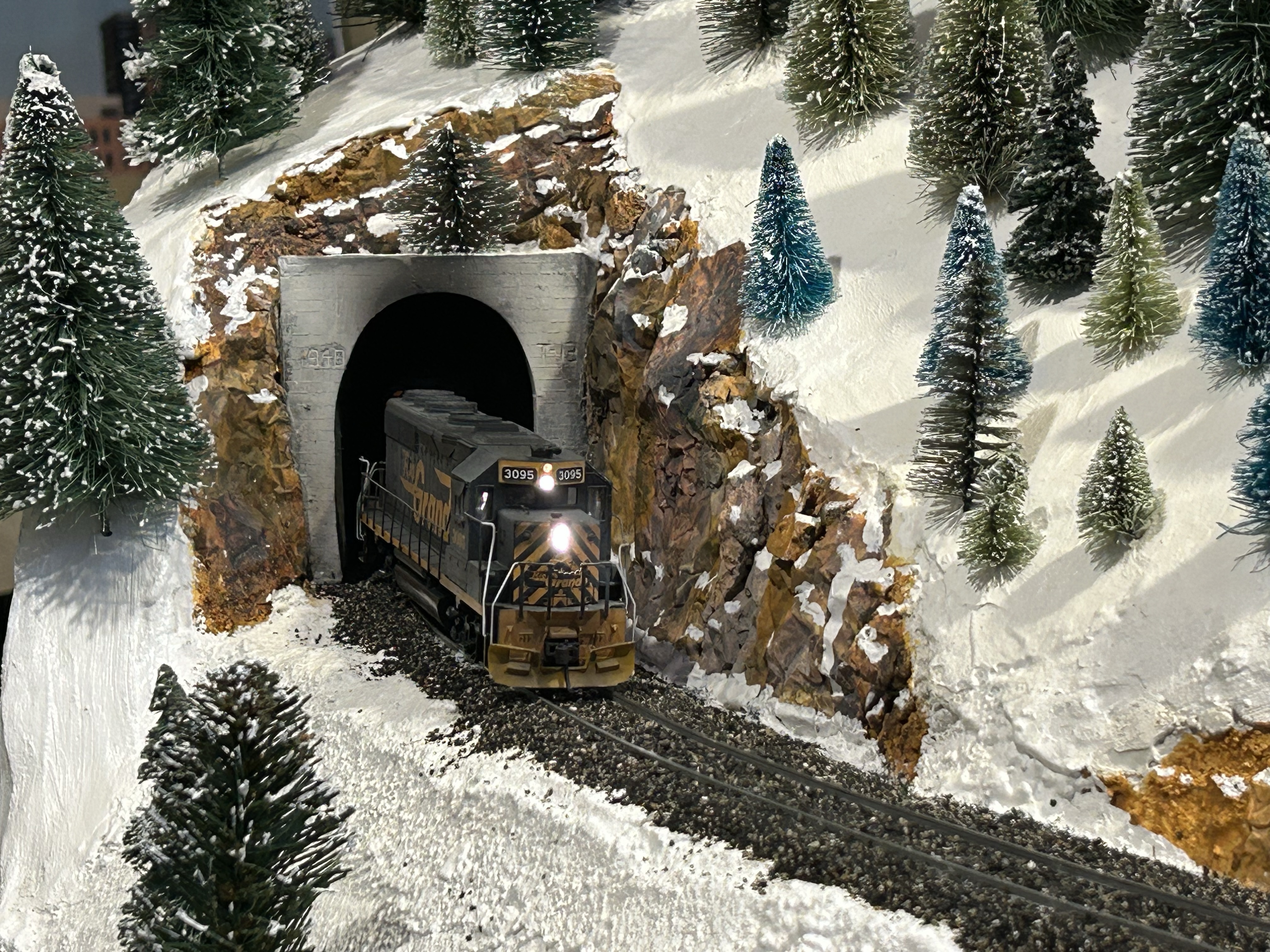 |
Here’s the west portal of Tunnel 13– which serves as the entry to the South Draw region. All of the portals here are the same basic, simple design. I cast them from a material called Perfect Cast, in a mold I built from styrene. Note the portal facings all have visible lines from the wooden forms used in building the real ones. |
 |
The sidehill cut/fill between tunnels 13 (left) and 14 (right). There are deciduous shrubbery and conifers growing in the talus, bare of leaves in the winter of course. That’s a UP SD60M peeking out of T14. |
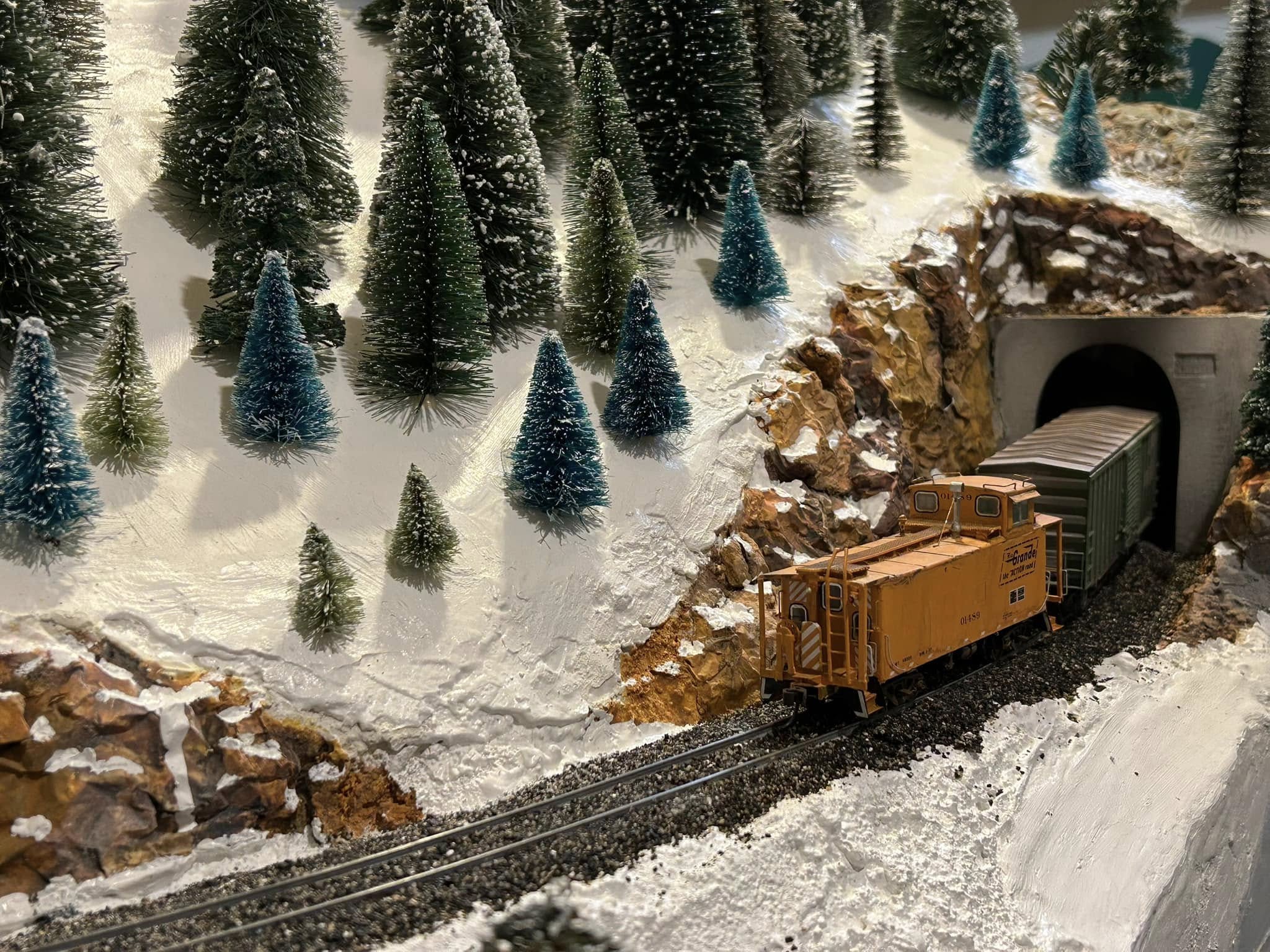 |
Just around the curve is the east portal of Tunnel 14 (which actually faces compass north). I cast all the rockwork using heavy-duty aluminum foil. Each rock face required multiple individual castings, joined together. I blended several shades of acrylic to achieve the natural rock colors, dusted it, sooted it, and highlighted with white latex to simulate snow accumulations. |
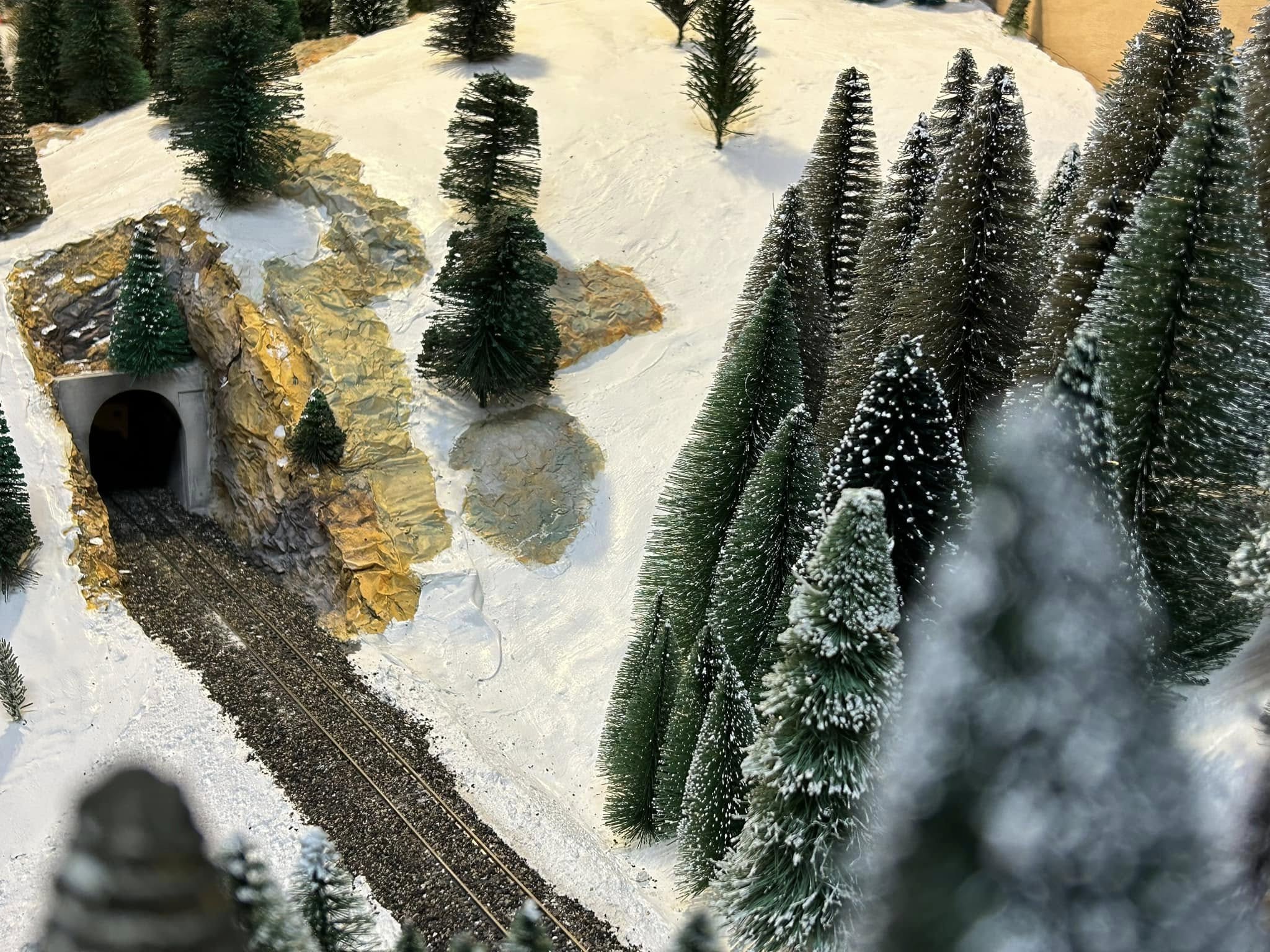 |
Here’s a look across the valley at the west end of Tunnel 14 (which faces south). This end lies back in a long cut through the soft geology of the ridge. In the foreground is a high fill that carries the track to the next tunnel, Fifteen. Note that the south slope of this ridge is much more bare of trees than the north side, a trait in common with the next ridge as well. |
 |
Here’s the east portal of Tunnel 15 (which faces north). Since the ridge shades the valley all winter, the snow is slow to melt near the tunnel. Same construction as described above. I did have to extend the wing of the portal face, matching the real one. Same with 14 EP above. Since this photo, I have added some deciduous bushes along the ROW, just like the real scene. |
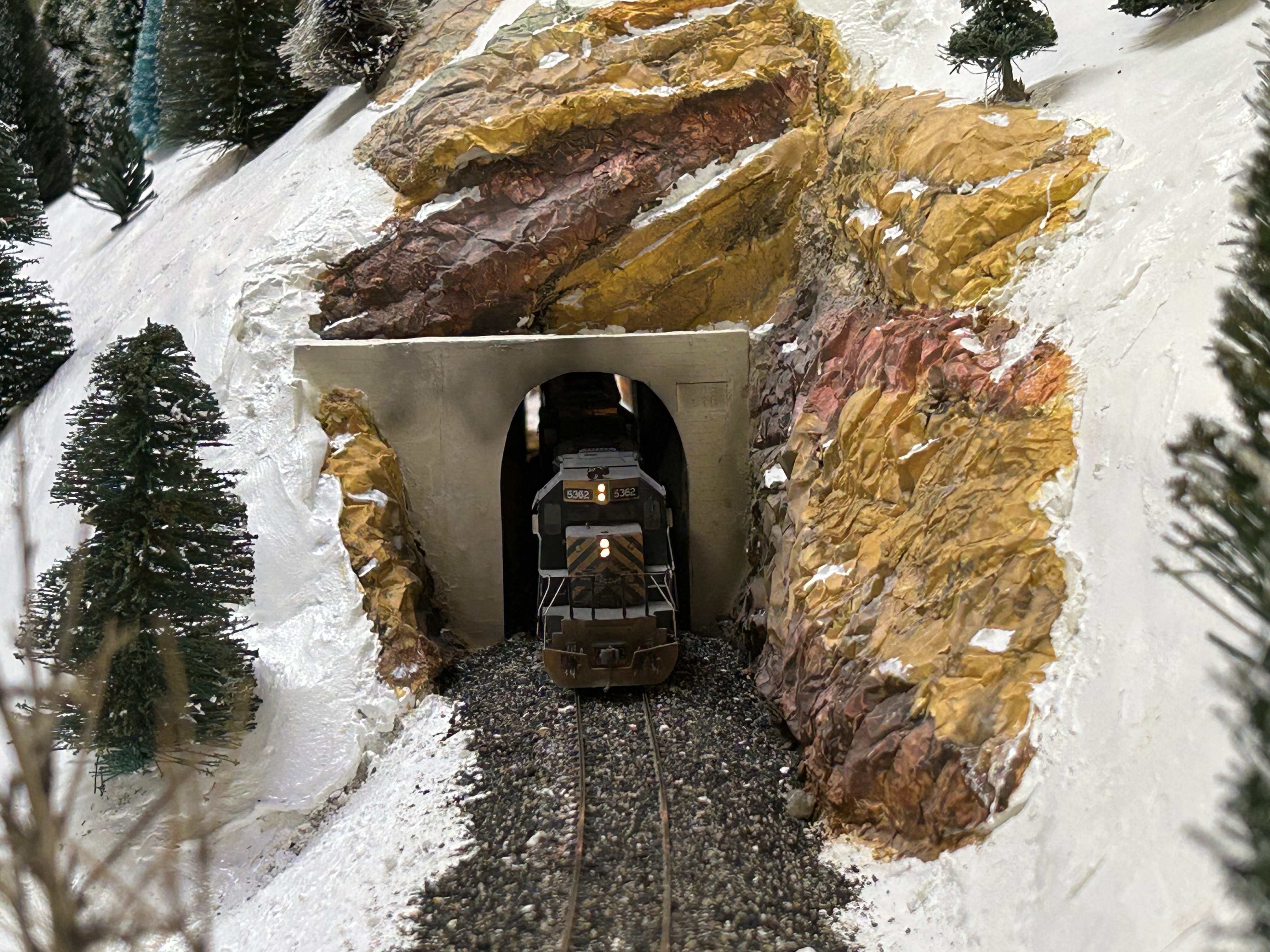 |
The west portal of tunnel 15 (facing south). This view is difficult under normal conditions due to the backdrop and the depth of the scene, but I fully scenicked it anyway. Note the tilting strata above the portal face. From ground level one can look through it and see tunnel 14 beyond. Tunnel motor 5362 is emerging from the tunnel. |
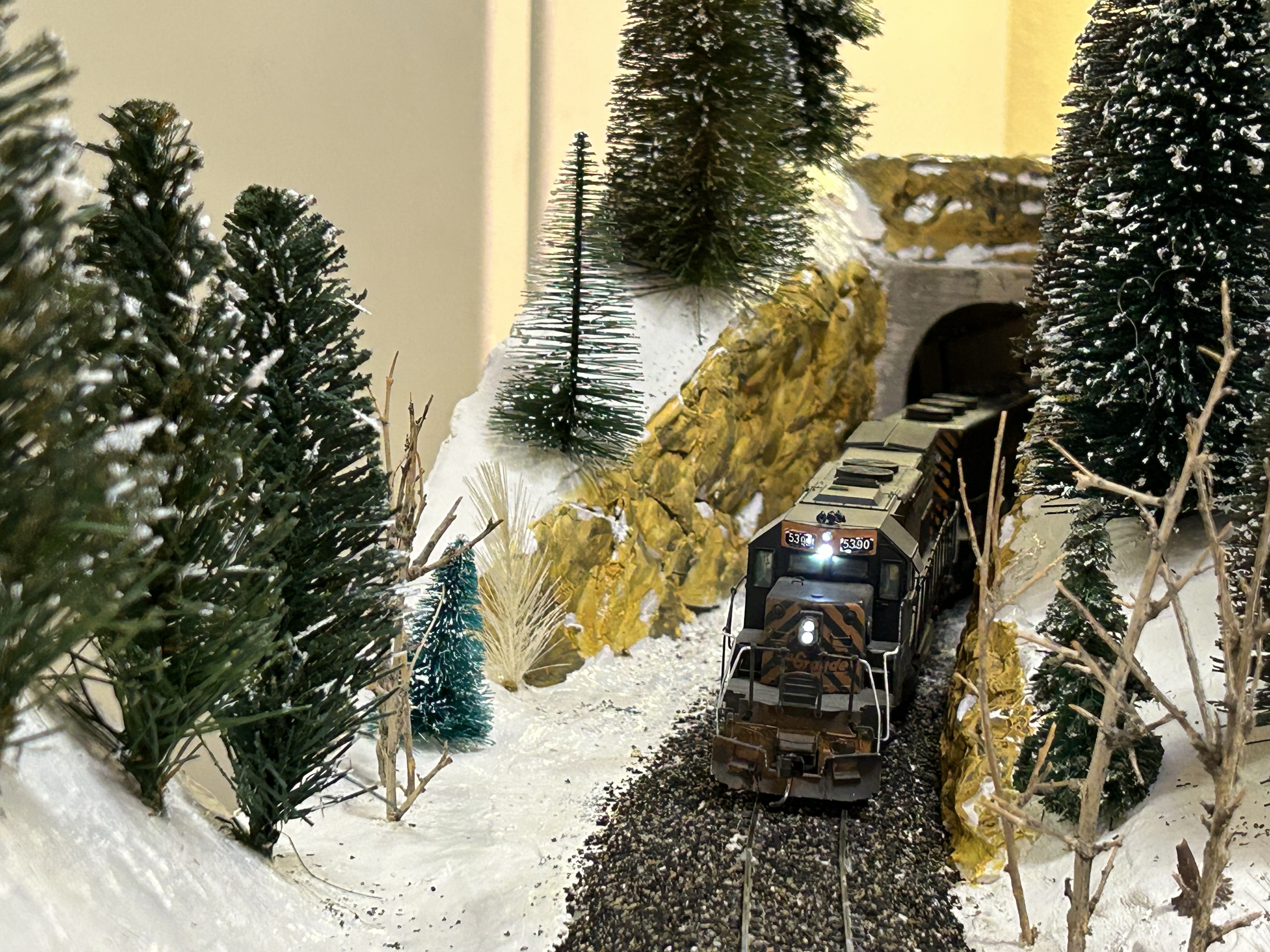 |
Here’s east portal of tunnel 16, hidden back in the long cut in the shallow-sloping hillside (just like the real thing). It’s difficult to see under any circumstance (just like the real thing) but here I have the backdrop out of the way, making this angle possible. Tunnel motor 5390 and friends are rolling down the grade towards the fill between 16 and 15. Tunnel 16 functions as the lower entry into the helix, which carries the rail up to West Portal. |
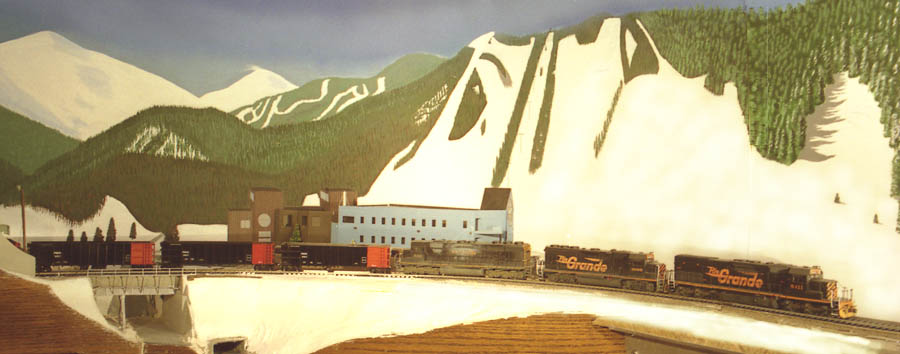 |
A hidden helix which represents the Moffat Tunnel. About 25 feet later, the tracks emerge from the West Portal and curve past the Winter Park Ski Area. Winter Park siding stretches down the “valley” to the north. |
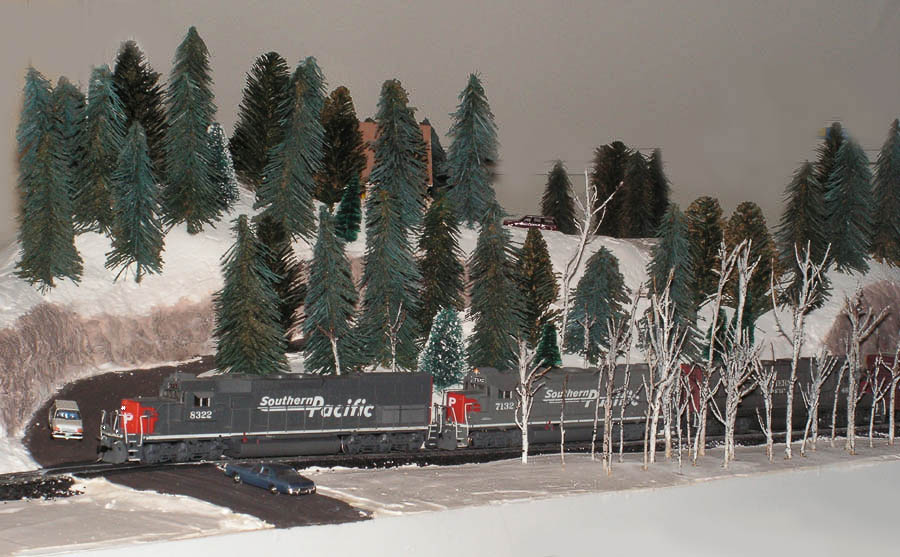 |
Beyond Winter Park, we come to the Hideaway Park area (the contemporary town of Winter Park). At this point is the upper reverse loop. (Photo: an eastbound manifest of all-SP power crosses Vasquez Road in Hideaway Park. The hill conceals the reverse loop.) |
I’ve been a fan of this stretch of track all my life, so I hate to pin the layout down to a single time period. That is why I take this multi-era approach. Of course, this means that I have far more rolling stock than is ever on the layout at any one time. Not that that’s a problem for me, you understand…

 Action Road