
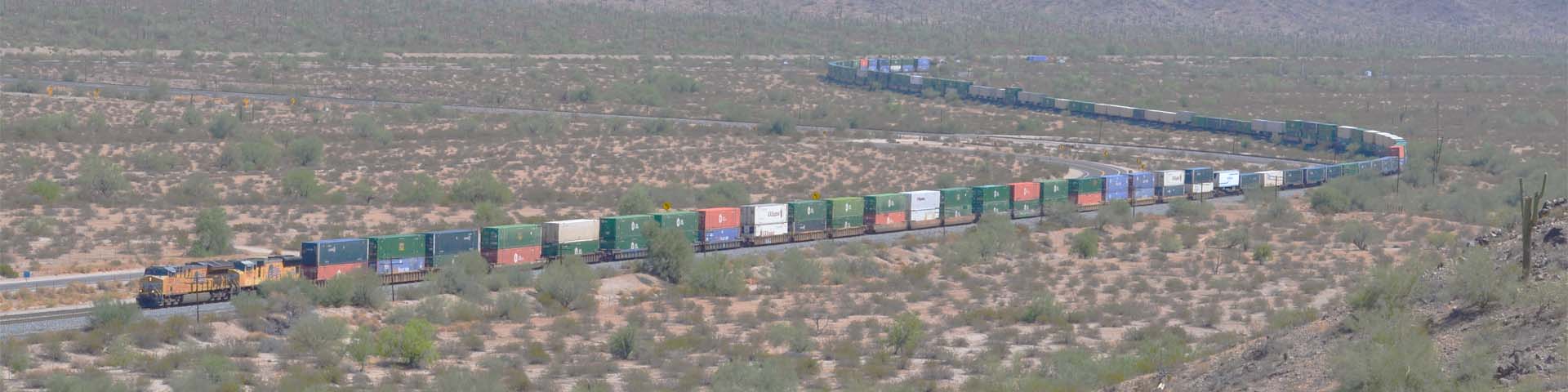
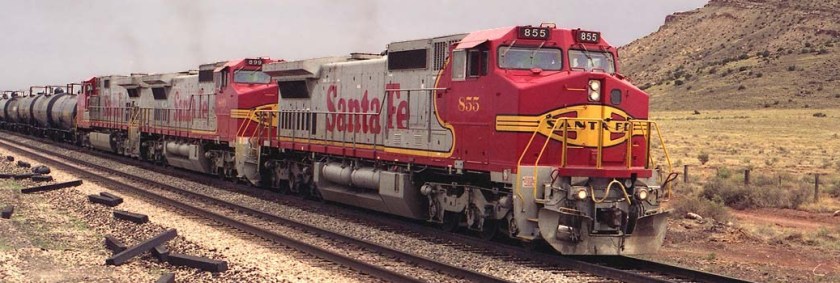
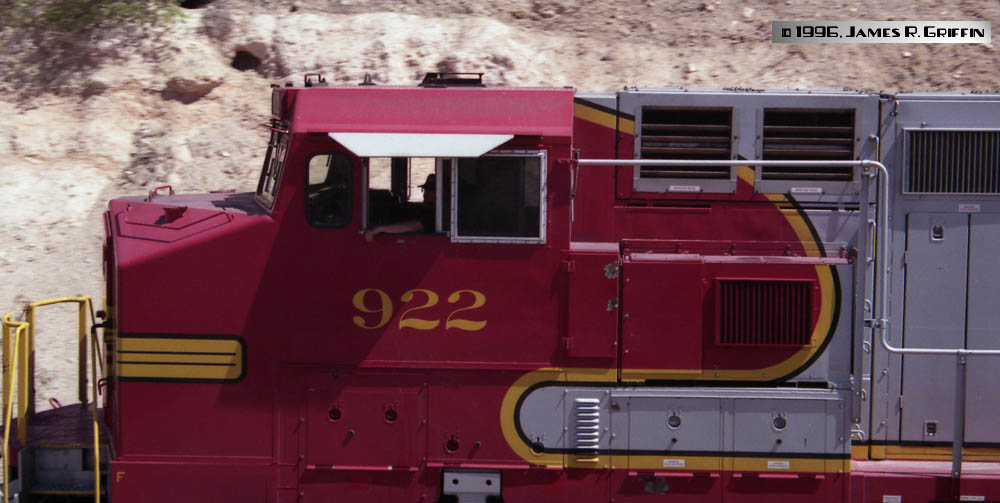
 Home Run. That’s the only way to describe the revived red-and-silver Warbonnet paint scheme, seen here close up on the cab of C40-8W No. 922. The original designers hit this one right out of the park, and it really worked on the modern GE locomotives.
Santa Fe’s “Warbonnet” paint scheme is one of the all-time classics in American railroading. Passing through several variations since its introduction in 1937, the design is instantly recognizable. A Warbonnet-clad locomotive says “Santa Fe” louder than anything else.
Warbonnets Across New Mexico
On several occasions between May 1994 and October 1997, I had occasion to be in Mountainair, New Mexico, and nearby locales. Mountainair is a hamlet adjacent to the summit of Santa Fe’s main line between Amarillo and Belen. The rails follow Abo Canyon up from the Rio Grande valley, which is a pretty steep climb to Abo Summit. To the east the ground is high and the grades more moderate.
It was fortuitous that I took these images, since they offer a glimpse of the last days of the Santa Fe before the BNSF merger.
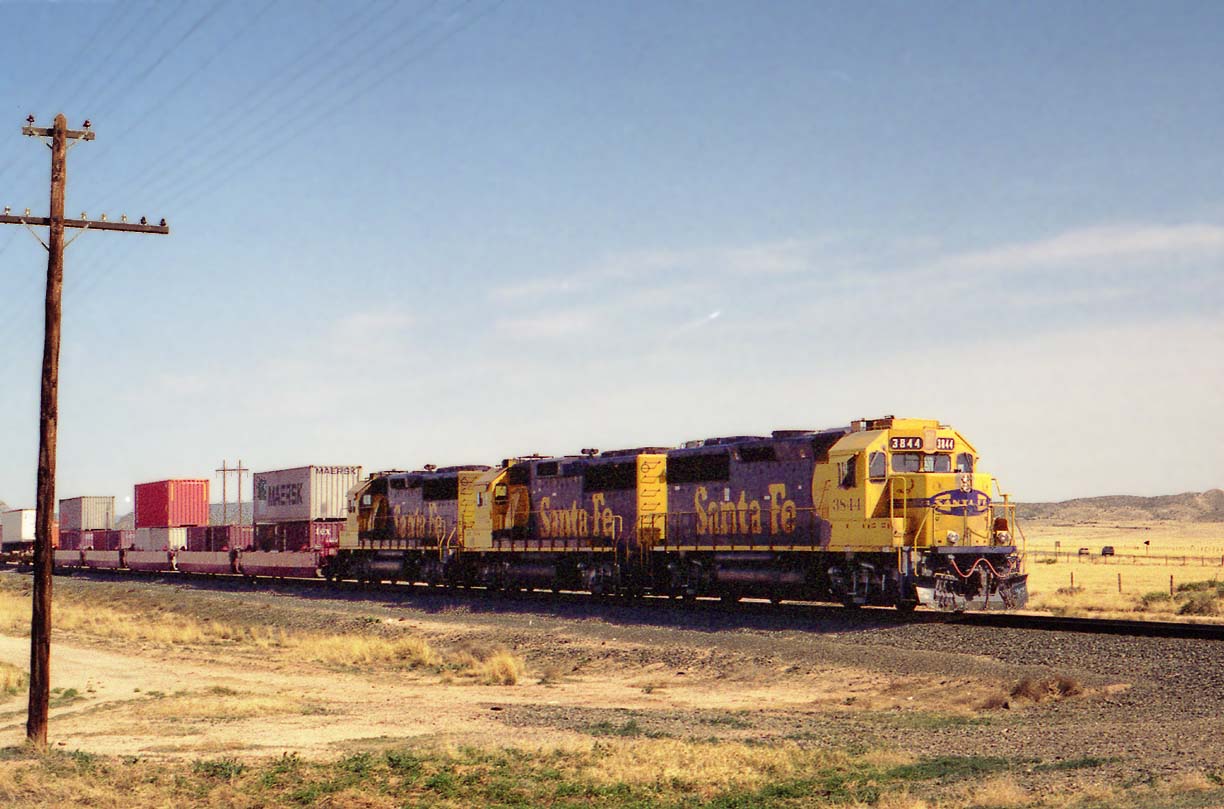 |
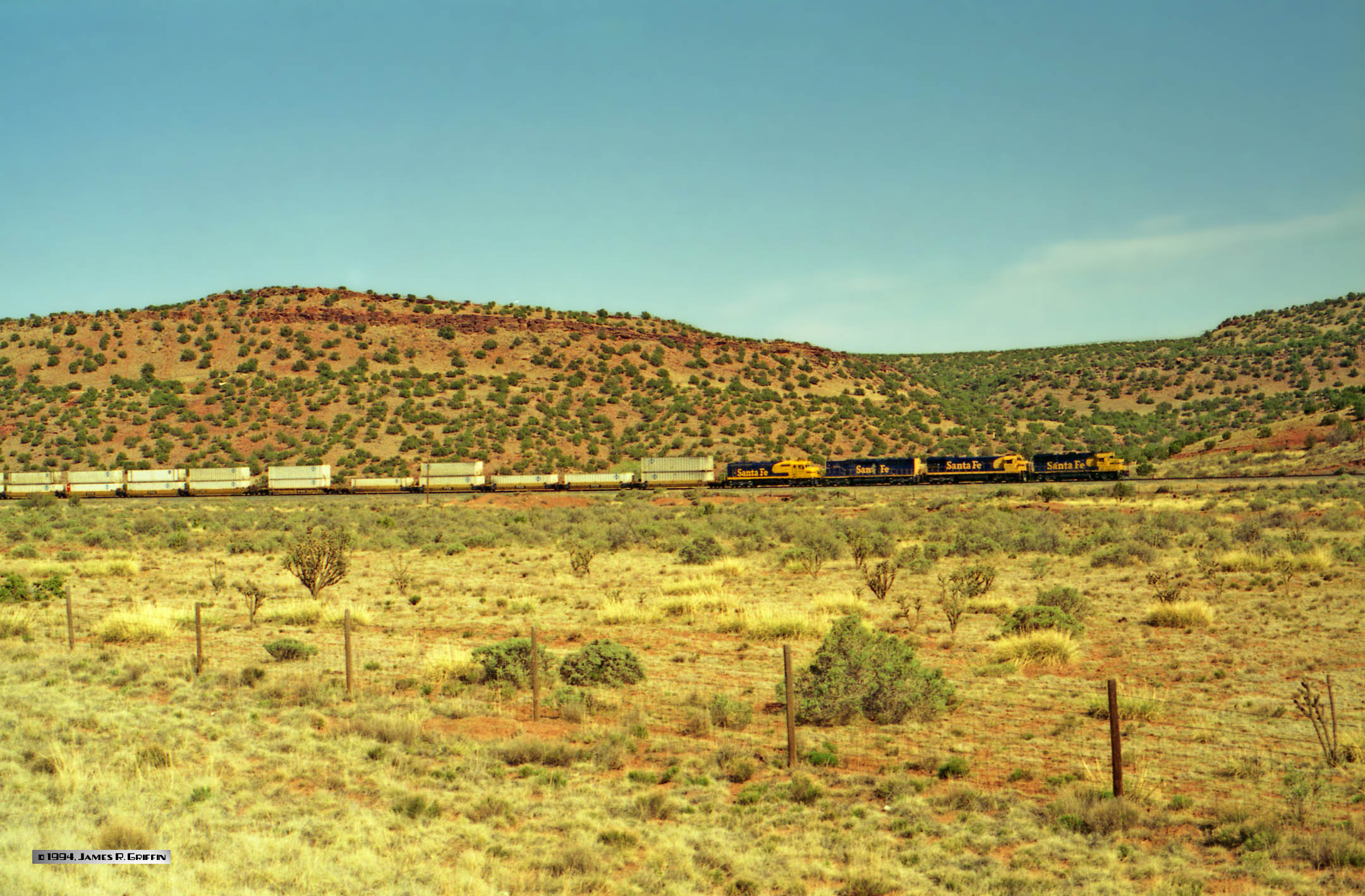
Highway 47 crosses the tracks east of Becker, and is usually a good place to see a train or two. Here a westbound intermodal powered by a matched trio of GP50s approaches the crossing… |
 |
… and rushes off towards Belen and the west. (5/06/1994) |
 |
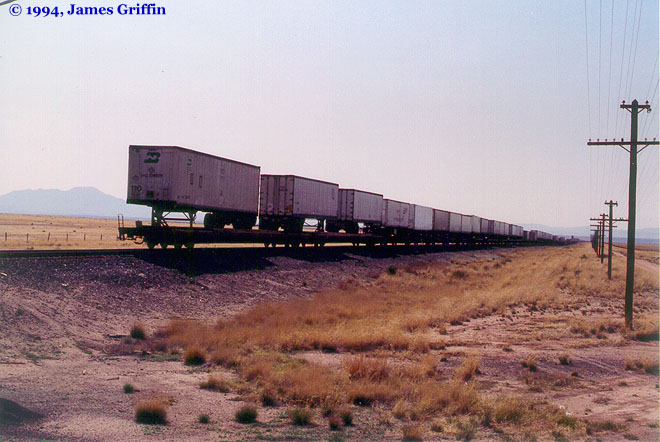
Endless intermodal trains are the rule on the AT&SF main. Here a westbound train approaches the end of double-track above the narrows of the canyon. (5/06/1994)Power looks like a GP60, SF30, SD45-2B, FP45u.UPDATED IMAGE |
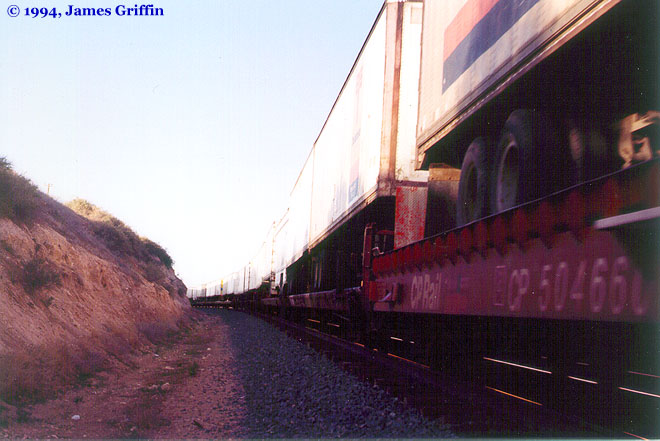 |
Walking in the west end of the cut at the summit, I was nearly caught by surprise by this westbound intermodal train. I don’t recommend standing this close to a moving train… especially one going so fast. I wouldn’t do this now– old age has made me smarter… |
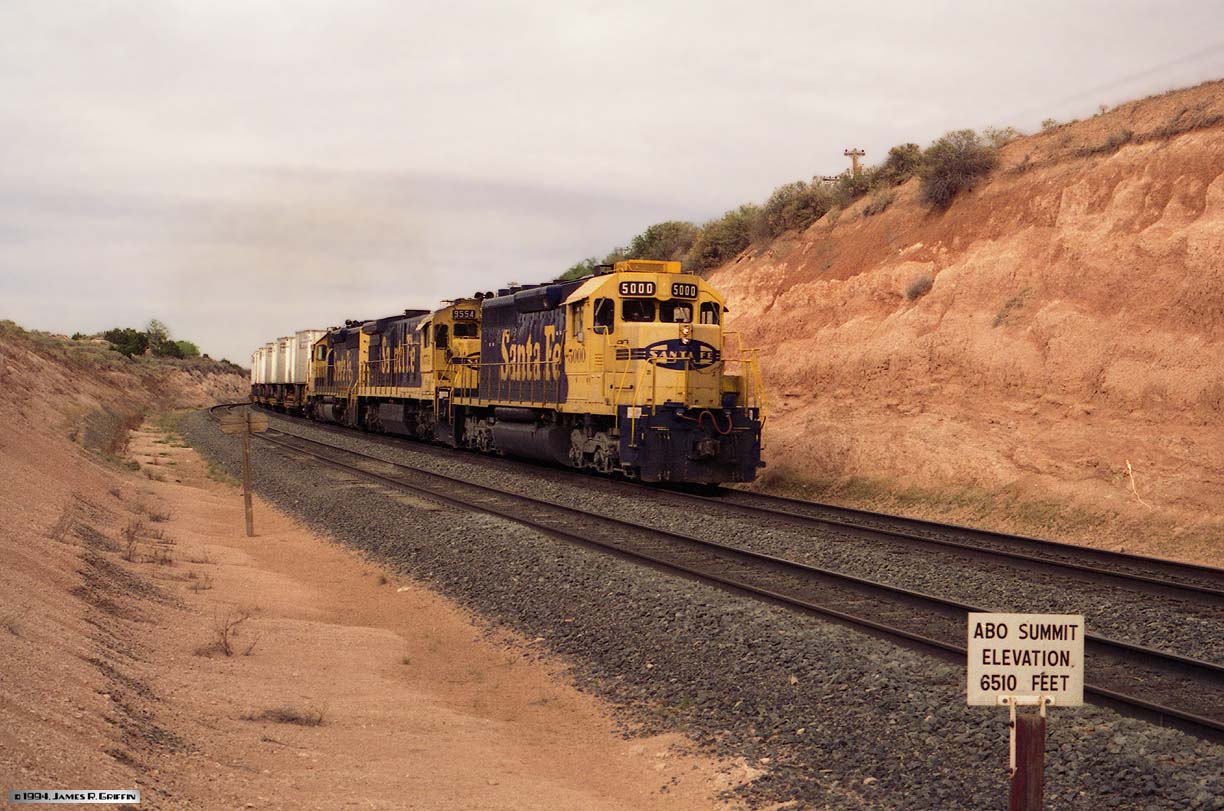 |
I finally managed to capture this signature shot at the summit. Coming around the curve, this train completely surprised me. SD40u No. 5000 is leading. (5/07/1994)If you ever visit here, be more careful than I was… |
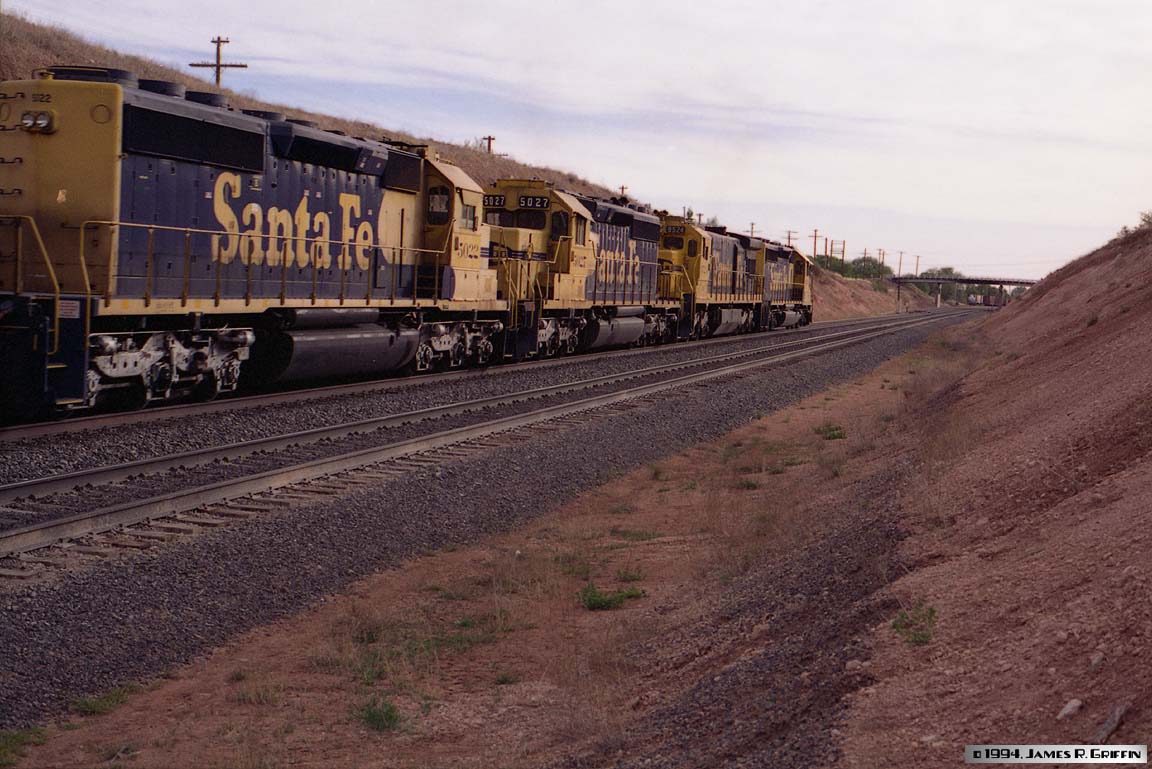 |
Here an eastbound intermodal with five 6-axle units has crested the summit and is headed towards the highway overpass in “downtown” Mountainair. (5/07/1994) |
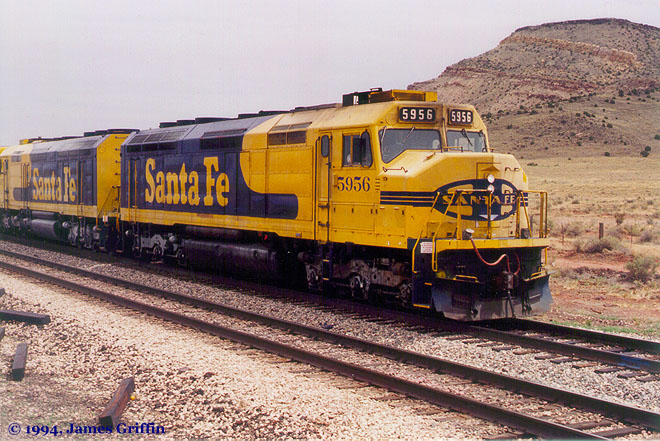 |
Later, a hundred miles to the west off Highway 6, I caught a set of three F45u’s westbound. This is between Belen and Laguna, close to Suwanee. (5/07/1994) |
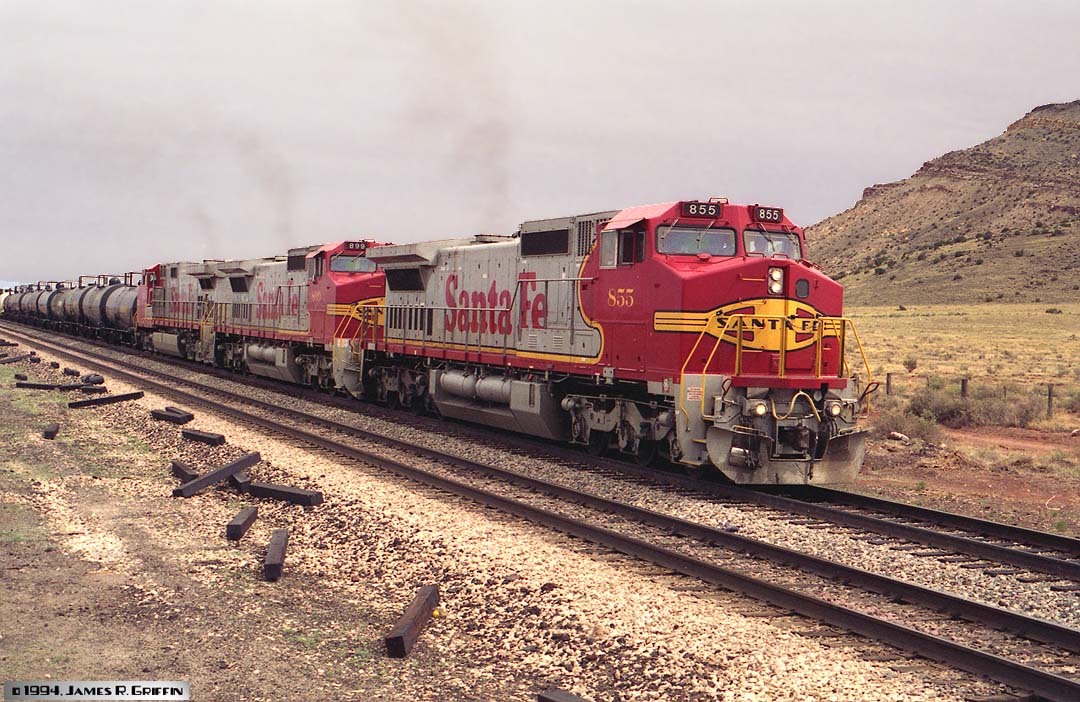 |
Two Dash-8’s and a Dash-9 have a westbound manifest freight at the same location as above. (5/07/1994 |
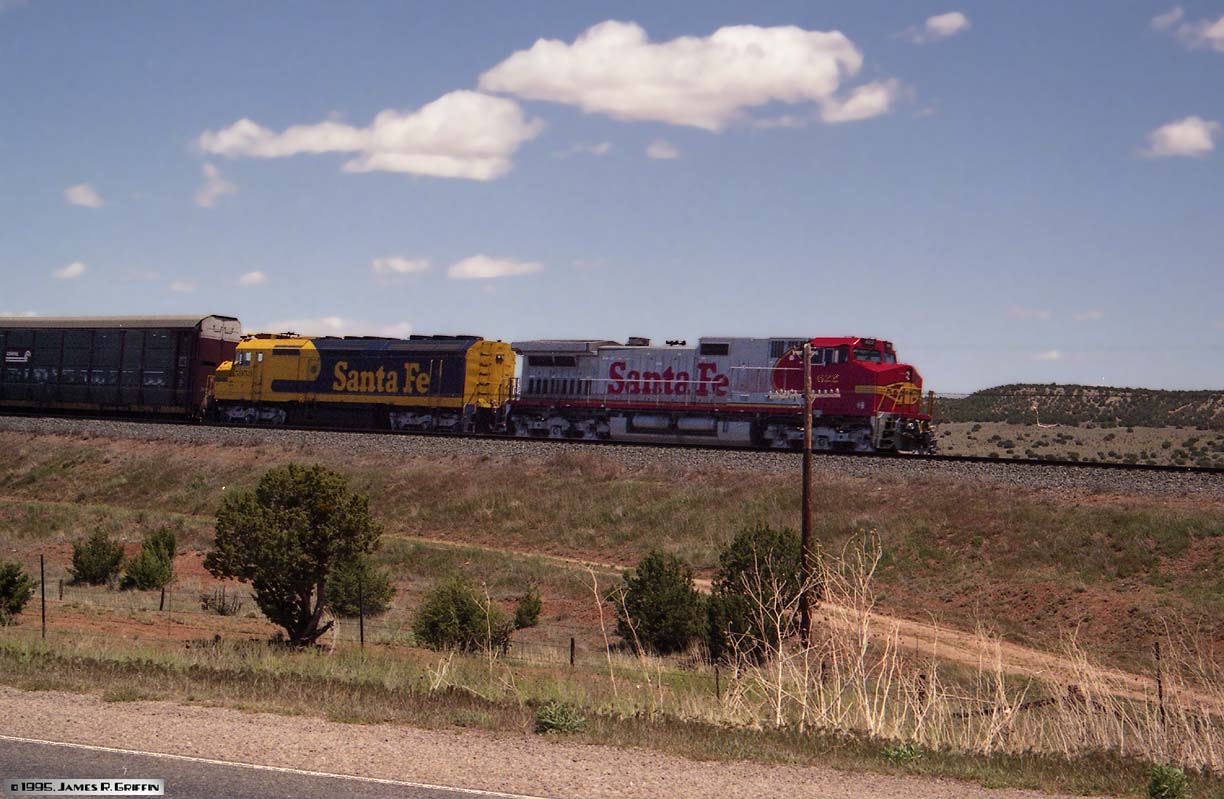 |
On May 13, 1995, a westbound autorack is a couple miles past the summit. Notice the interesting mix of power: Dash 9-44CW (alternately, a C44-9W) and F45. Fun to see two versions of the Warbonnet running together like this. |
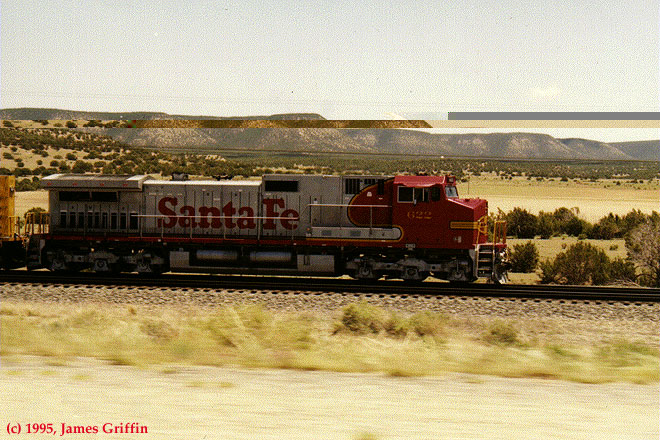 |
Here’s the same train, further west near Abo– a classic pacing shot. (5/13/1995) |
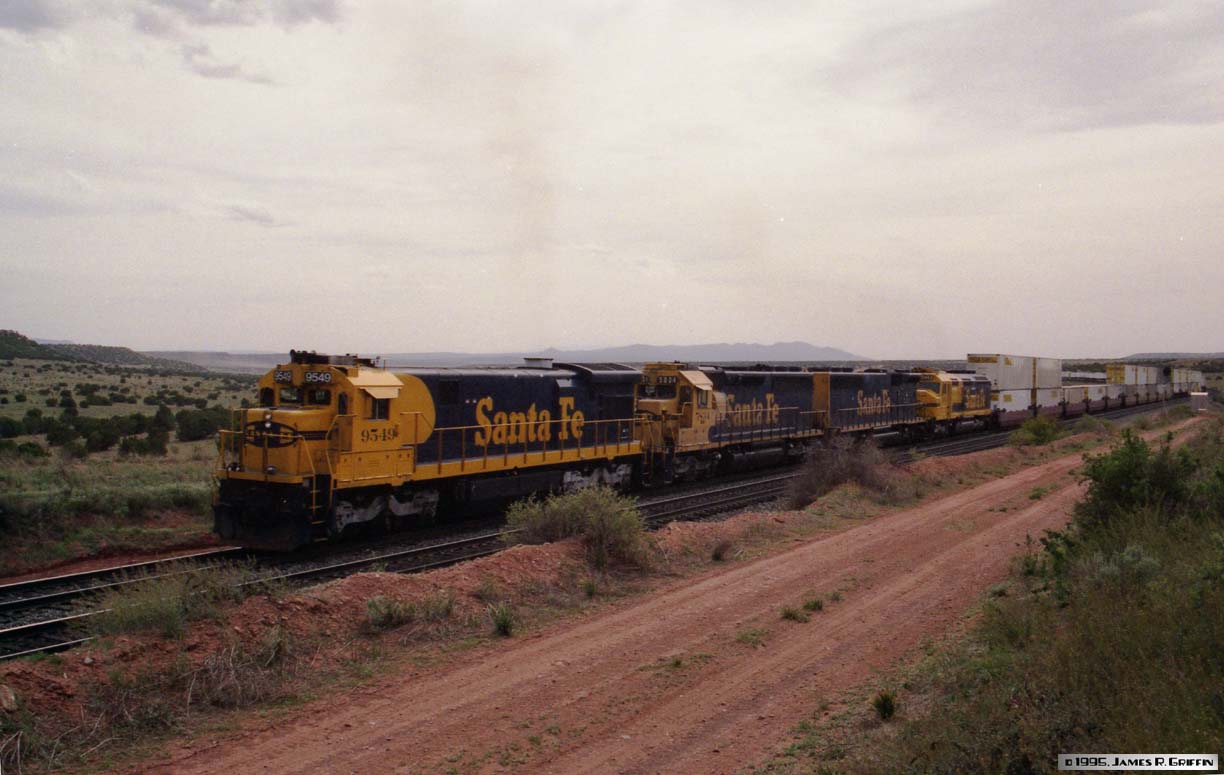  |
The J.B. Hunt company had a close relationship with the Santa Fe, and shipped hundreds of trailers and containers daily.TOP: Here an eastbound JB Hunt train grinds up the tangent just west of the summit. U36Cu (SF30C) No. 9549 is on the point. (5/12/1995)
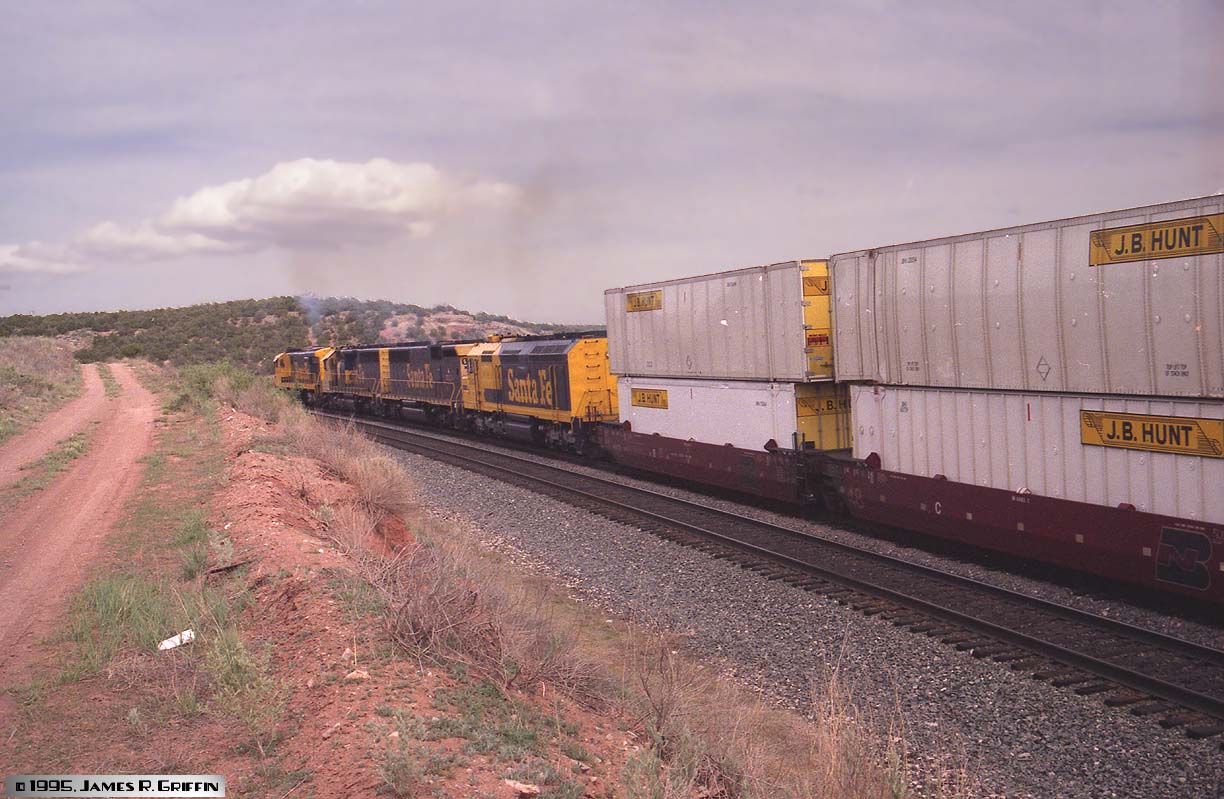
BOTTOM: Same train, going away, showing the styles of containers in use (soft-sided 48-footers on top, rigid 45’s on the bottom). Also note that the well cars are BN– a foreshadowing of the imminent merger. |
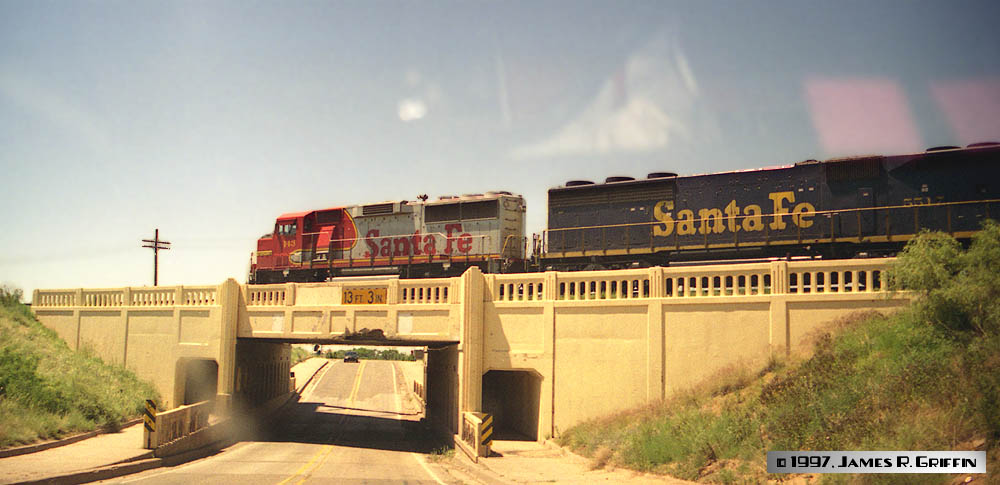 |
Thru-the-windshield grab shot of GP60 No. 143 and SD45-2B No. 5517, as they cross the overpass in Fort Sumner eastbound, late June 1997. This was an interesting match-up of locomotives. No. 5517 is particularly interesting, having been originally standard SD45 No. 5700, painted into the Bicentennial scheme in 1975, then rebuilt as a B unit in 1988. This shot, though post-merger, shows Santa Fe in a Santa Fe setting, so I placed it here rather than down below… |
| Sandy clay, scrub grass and tumbleweeds, hot sun and chilly winds carrying dust are constant companions in New Mexico. It’s a harsh environment, yet the Santa Fe ran an absolutely first-class operation there. Now BNSF continues the tradition. | |
Warbonnets in Arizona
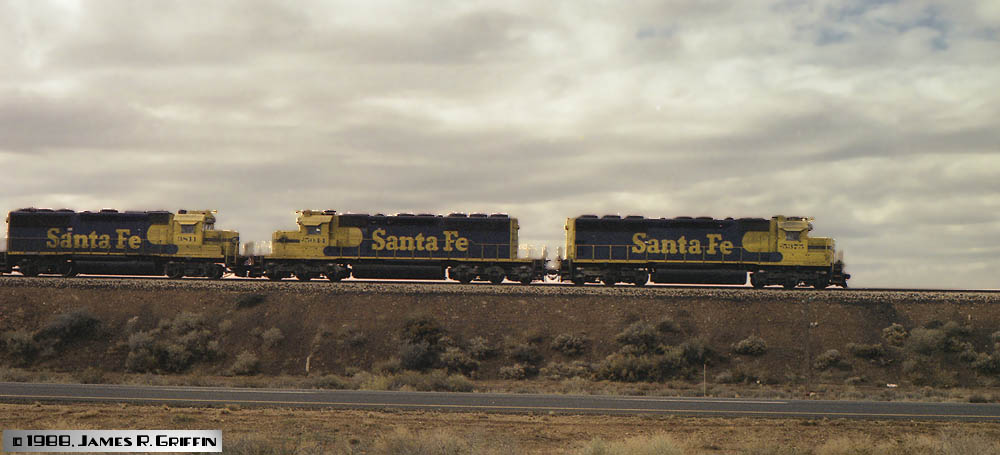 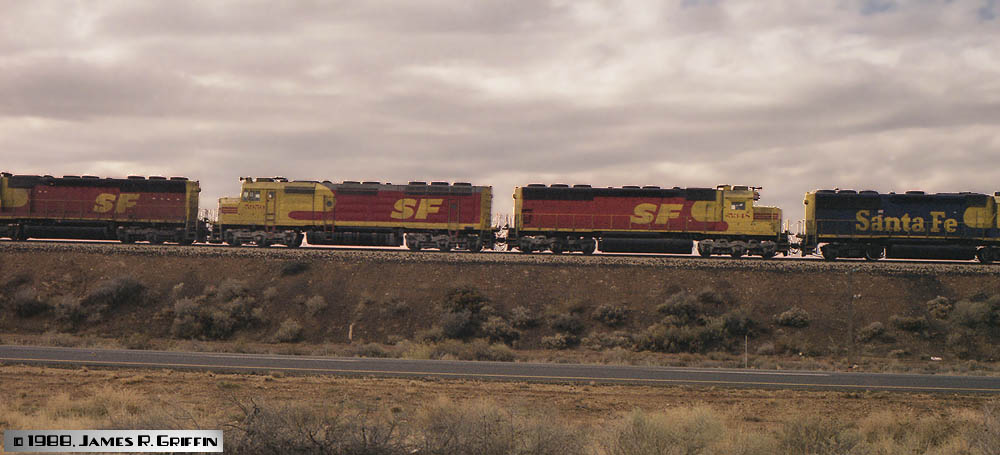 |
One morning late in March 1988, I photographed this westbound train just west of Winslow, Arizona. Half of its six units were still wearing the paint scheme from the recently-thwarted SPSF merger. Leading is SD45u No. 5375, followed by SD40-2 No. 5044, GP50 No. 3811, SD45u No. 5348, F45u No. 5950, and another SD45u. This was a bunch of horsepower for a fairly short manifest freight train. |
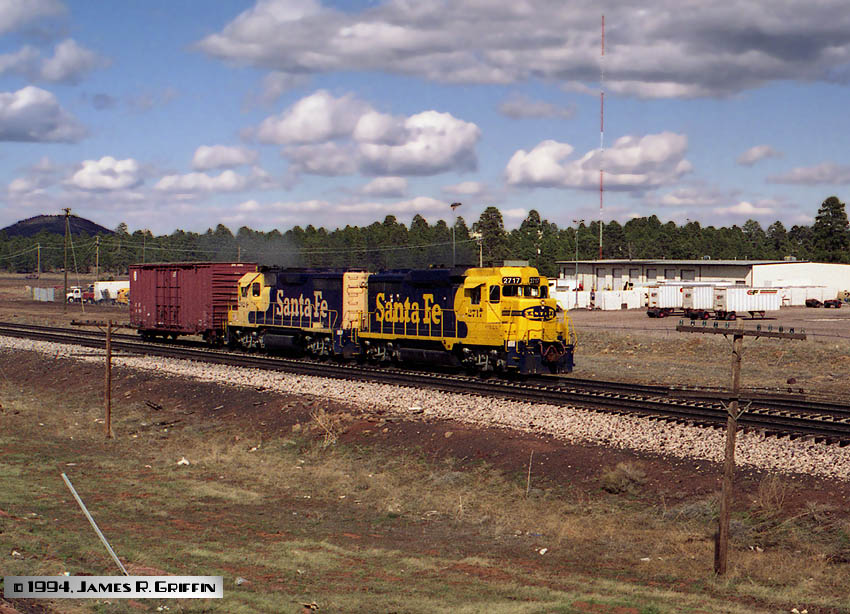 |
April 1994, I photographed this local switching movement in Flagstaff, AZ. GP30u No. 2717 is leading at the moment. |
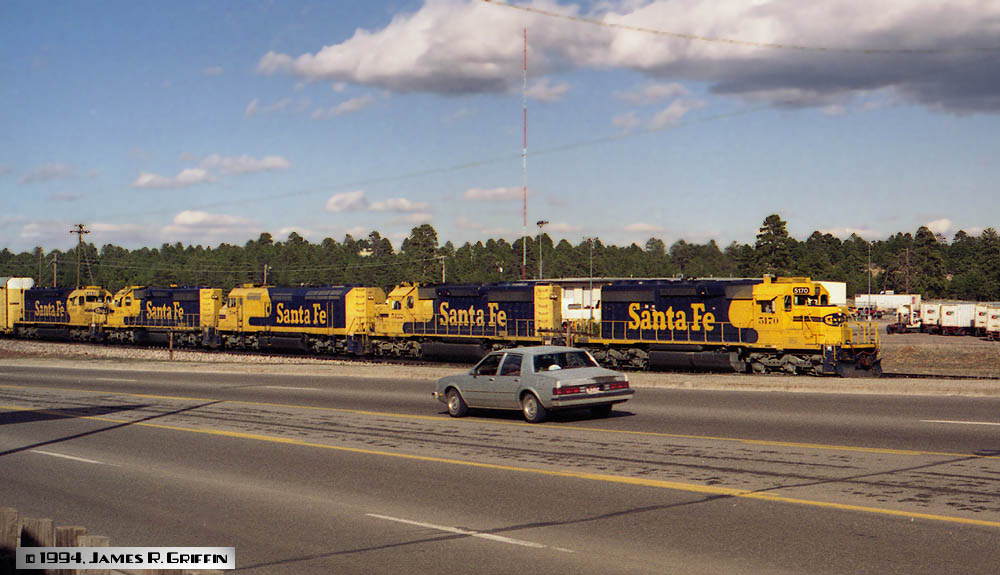 |
A westbound autorack train with a typical selection of Santa Fe power moves through Flagstaff, on the same day as the train above. SD40-2 No. 5170 is on the point, with snoot SD40-2 No. 5122 next, plus three more units in blue-and-yellow. |
Warbonnets in Colorado
I do not have many shots that fall in this category, and most of these are post-merger, but here you go…
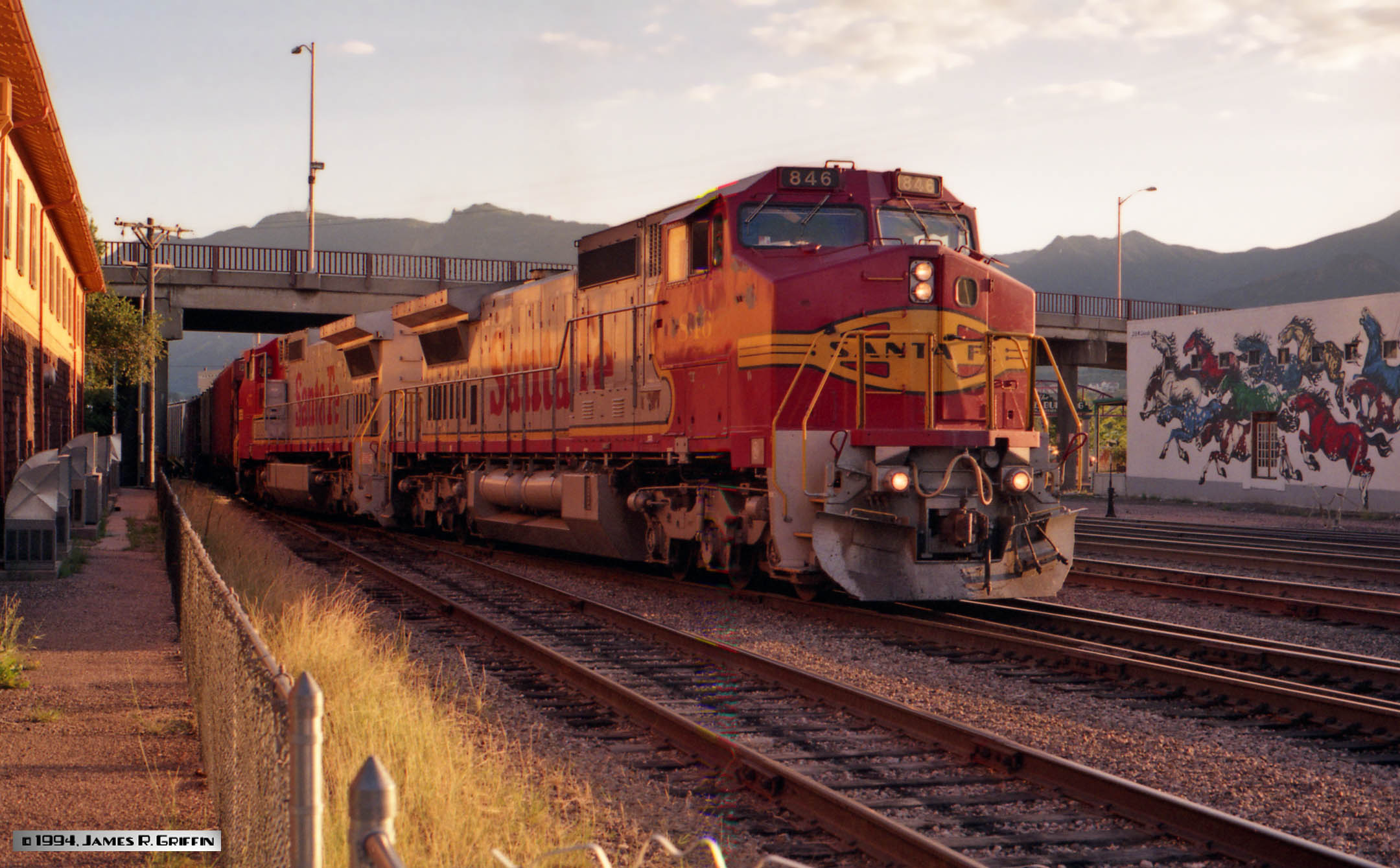 |
A pair of Dash-8’s, with No. 846 on the near end, cut in some cars in the Colorado Springs yard on 9/15/94. That’s quite the mural to the right. The old D&RGW depot is the building at left. One of my favorite photos… (See here, here, and here for more photos taken on this day) |
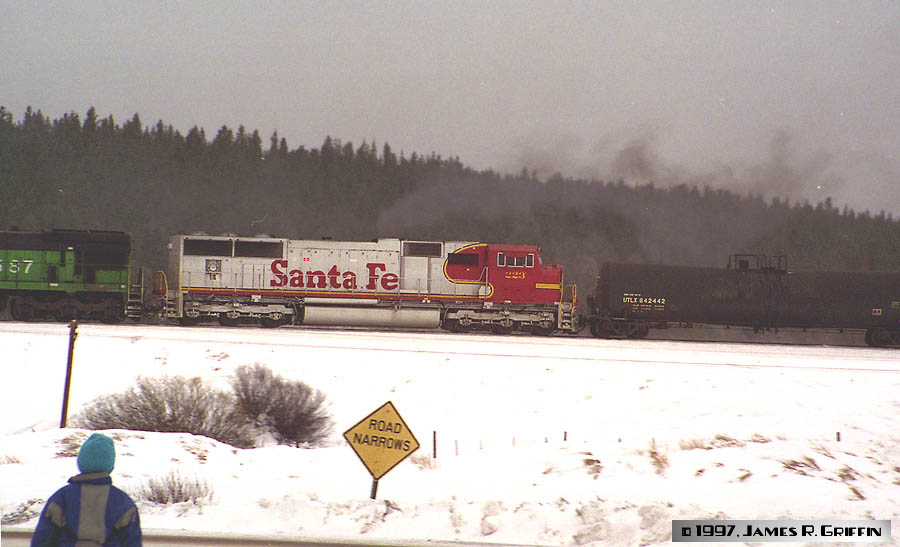 |
On 12/28/1997, an eastbound trackage rights BNSF train is hitting the 2% grade at Fraser, CO with SD75M No. 223 as the trailing unit. |
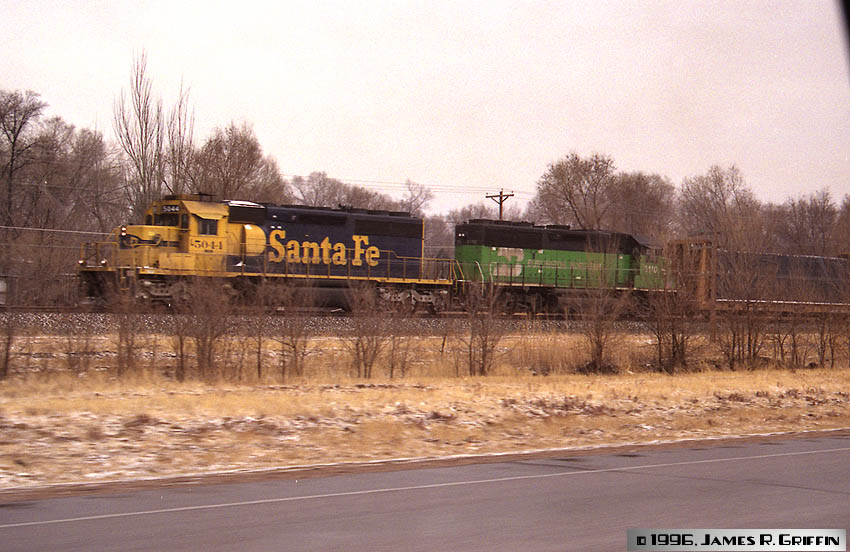 |
Not long after the merger (February 1996), SD40-2 No. 5044 is leading a short northbound manifest at Fountain, Colorado, on the joint line. |
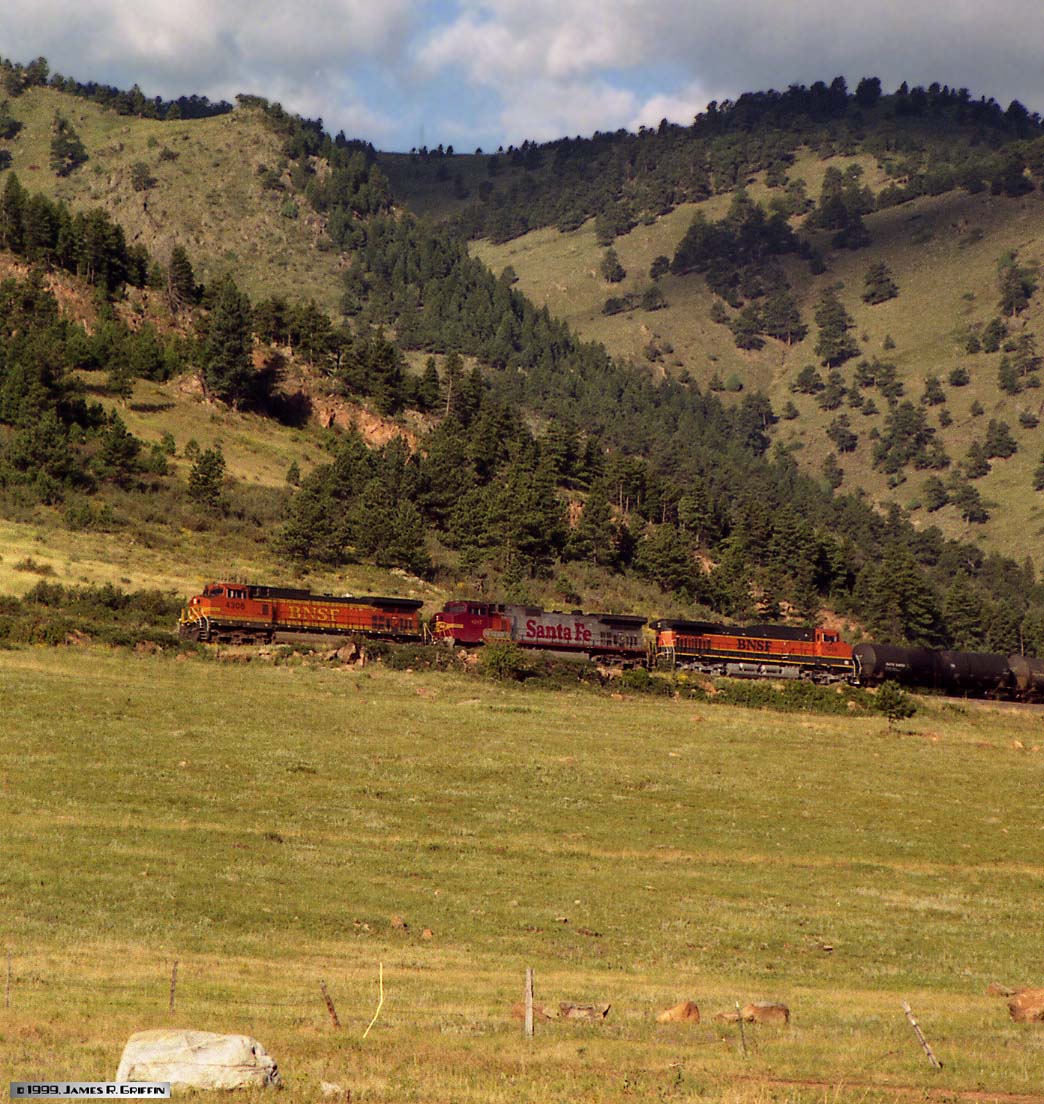 |
In 1999, a Santa Fe Dash-9 is in the middle of a BNSF trackage rights train exiting Coal Creek Canyon on the former D&RGW route. |
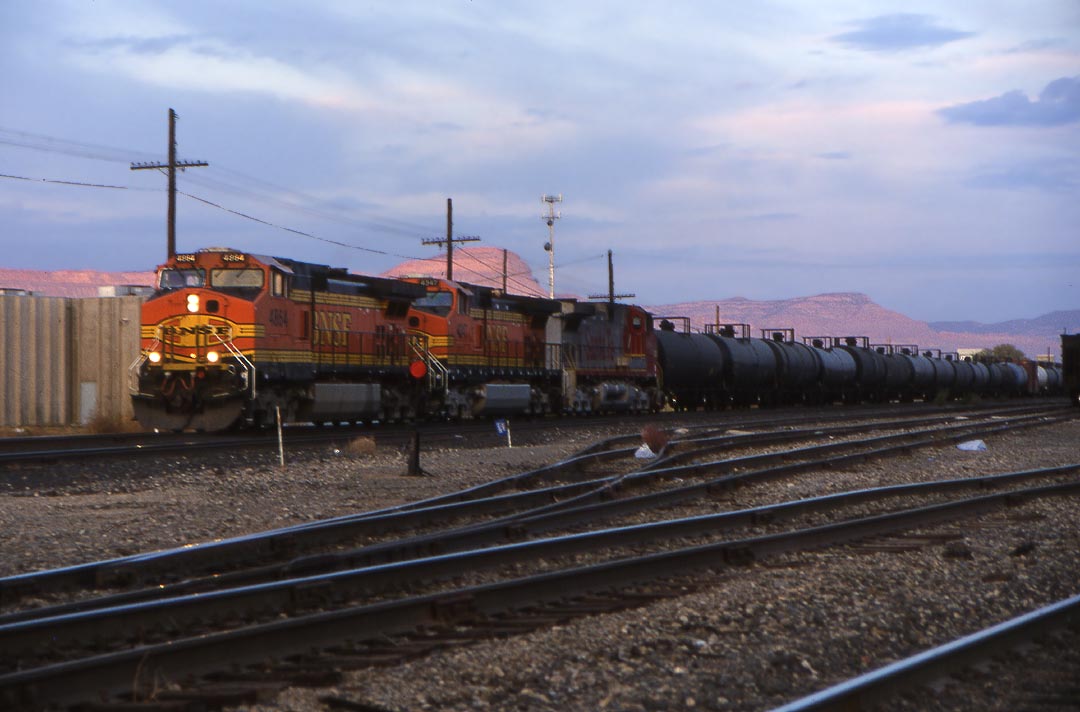 |
A westbound BNSF freight pauses at Grand Junction to change crews on the evening of November 11, 2001. An unpatched Santa Fe C44-9W is running third on this train. |
Warbonnets in Transition
The periods just after mergers are usually hard on railfans, especially if they have a strong attachment to the previous roads. Looking back, however, these times show to be extremely interesting, with a wide variety of equipment mixed together, and running in locales where it was never seen before. Such was the case in May 1996 when I made yet another trip to the Abo Summit area. BN equipment was becoming common, but solid sets of AT&SF power were still a regular occurrence.
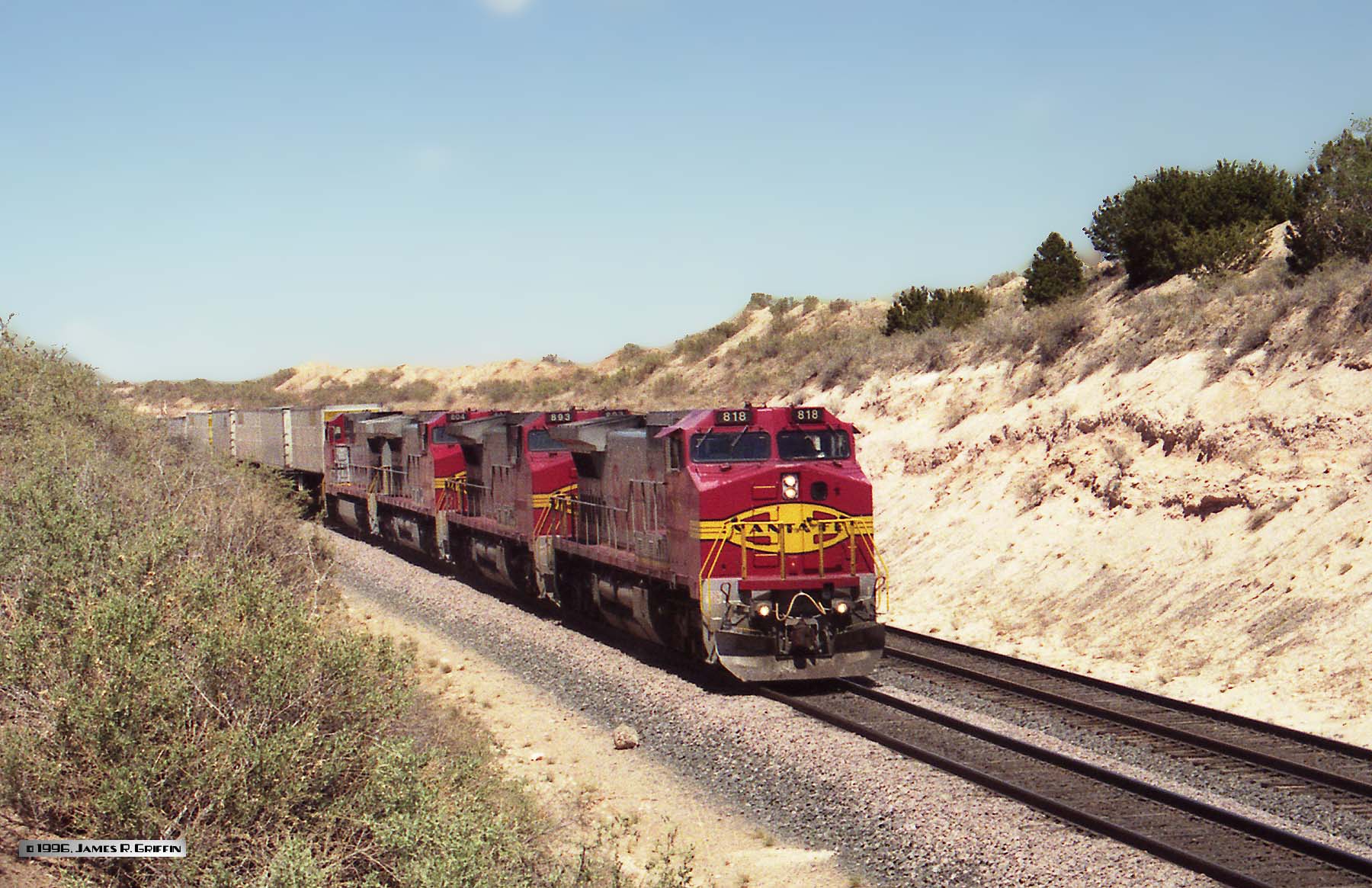 |
Pure Santa Fe: Two Dash-8’s (818, 893) and a pair of C44-9W’s fly past with a westbound intermodal train at Abo Summit. UPDATED IMAGE |
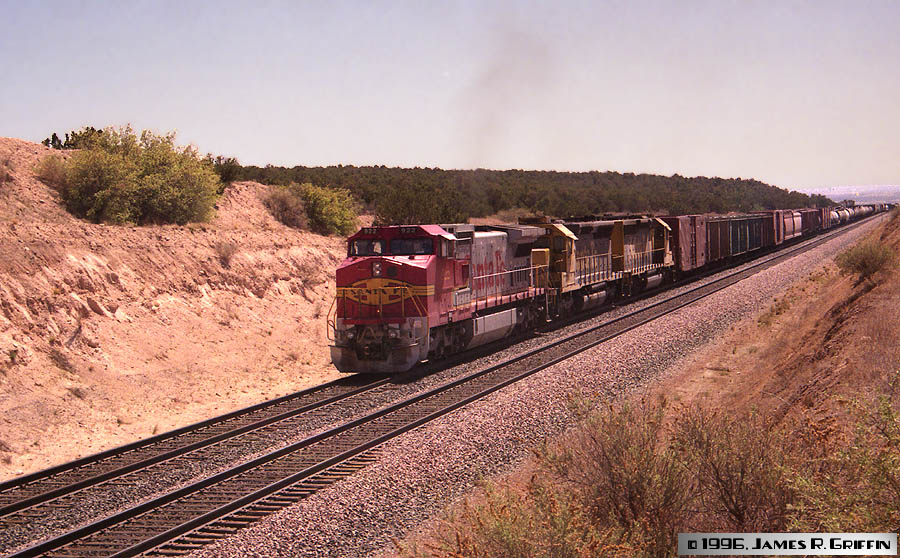 |
More Pure Santa Fe: an eastbound manifest freight grinds slowly up to the summit. C40-8W No. 922 leads, with an SD45u and SD40u on the drawbar. It looked to me like they sorely needed at least one more unit on this train… |
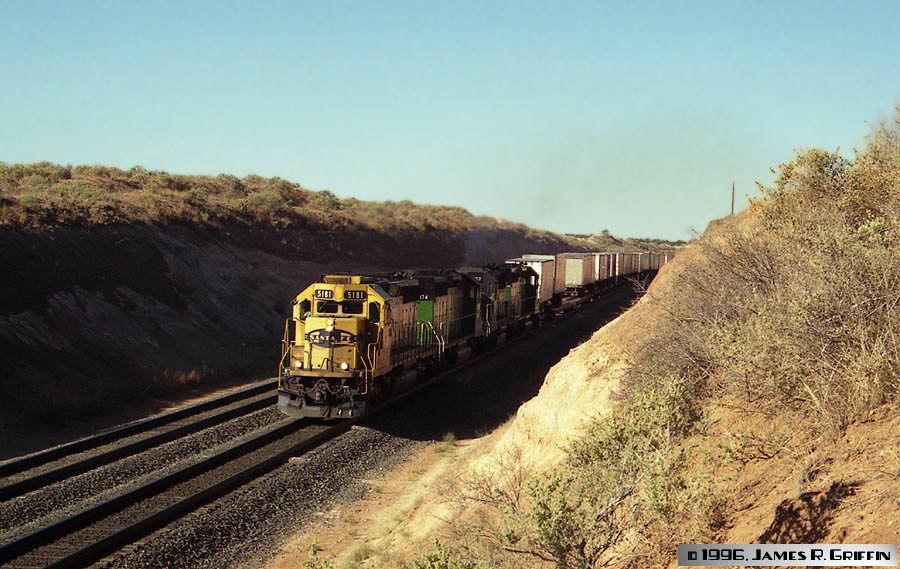 |
Next morning, this eastbound pig train had ATSF SD40-2 No. 5181 on the point, followed by three BN alumni. No doubt now about it being in the post-merger era. |
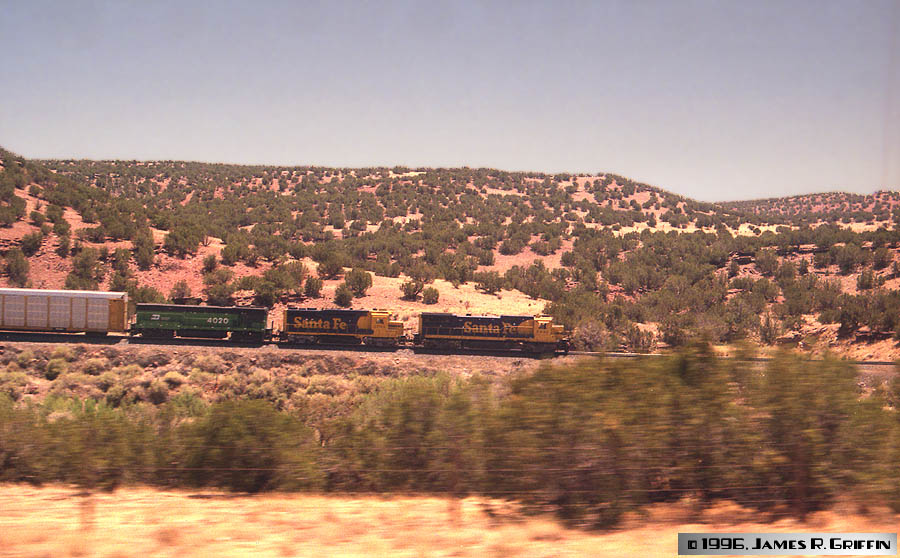 |
West of the summit, this autorack train had quite a variety of power, with B40-8 No. 7442, GP30u No. 2784, and BN B30-7A No. 4020. Too bad the photo was backlit. |
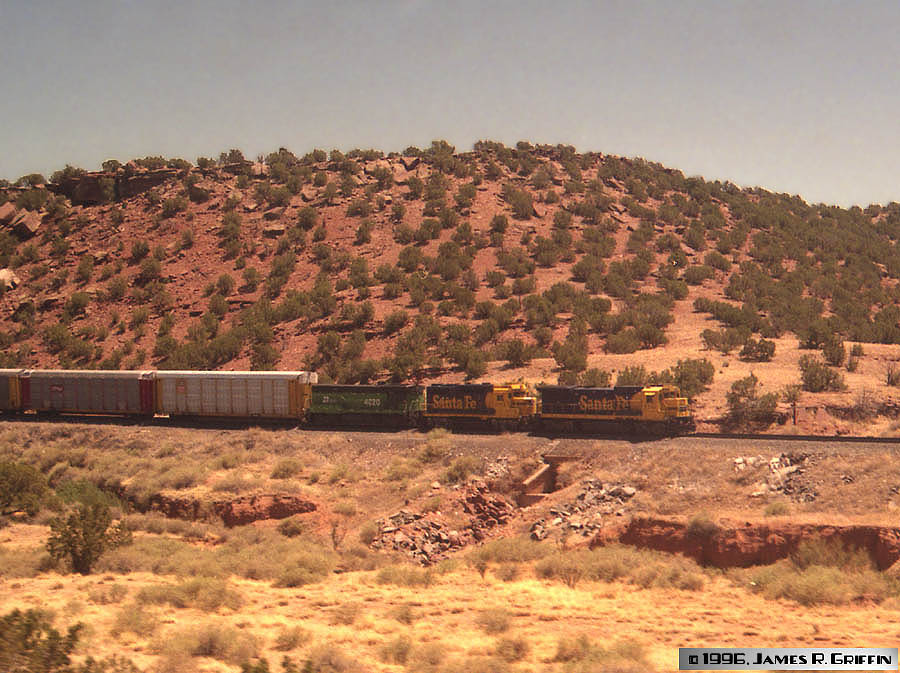 |
Another look at the same train, approaching Scholle. |
Warbonnets on the BNSF
After the merger, BNSF experimented with a variety of paint schemes. One was based on traditional AT&SF colors (essentially the red-silver warbonnet with BNSF letters); another drew heavily on the Great Northern colors of the past (Heritage I, or H1); yet another blended the Santa Fe blue-yellow with the GN scheme (H2). Mix these with the two Santa Fe schemes still running and the various BN green schemes, and you had a rainbow of locomotive paint. This continues to the present, though the BNSF orange has come to dominate.
A couple of days near Mountainair, October 10-11, 1997, revealed just what a variety could be seen on any given day.
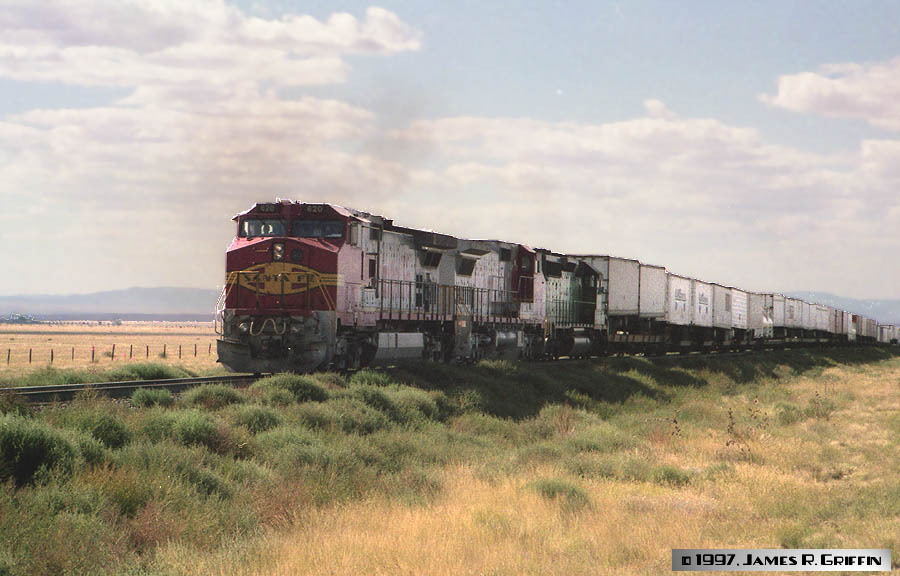 |
Early afternoon on October 10th, this eastbound pig train approaches the grade crossing at Sais. It has C44-9W No. 620 and on the point, with C40-8W No. 809 and BN SD40-2 No. 7115 assisting. |
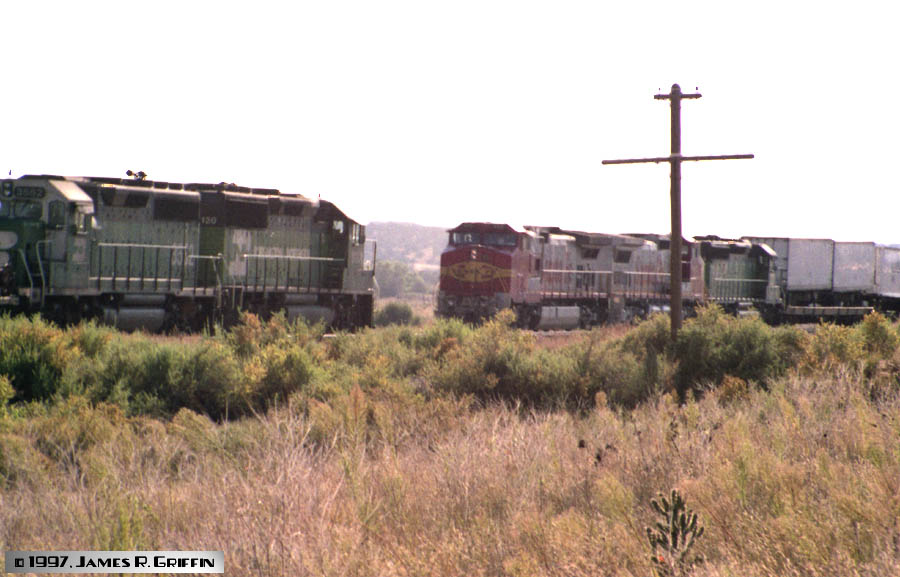 |
A few miles east, at Abo, the same train meets a westbound baretable with a pair of BN geeps for power. |
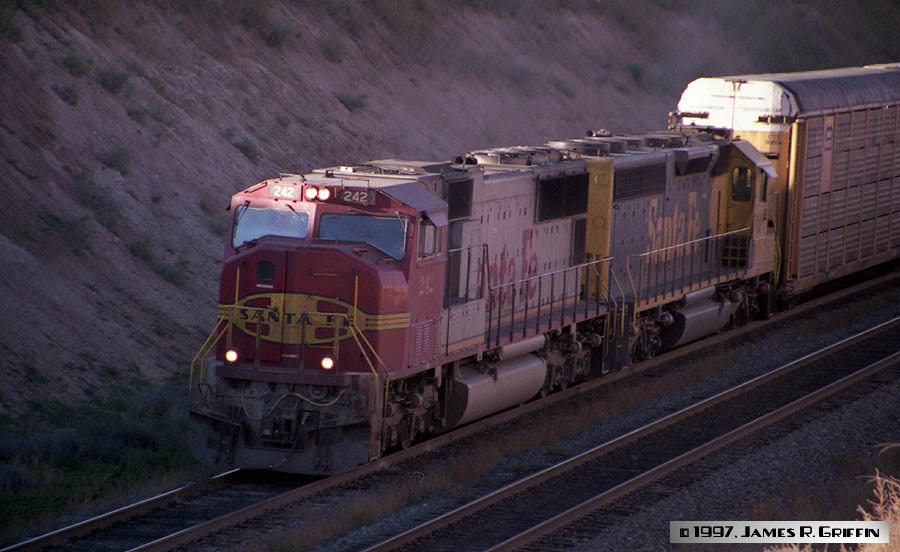 |
Early on October 11, this eastbound rack train passes through the cut at Mountainair at Abo Summit, led by SD75M No. 242 and SD45-2u No. 5810. Neither has been “patched” yet with BNSF lettering. |
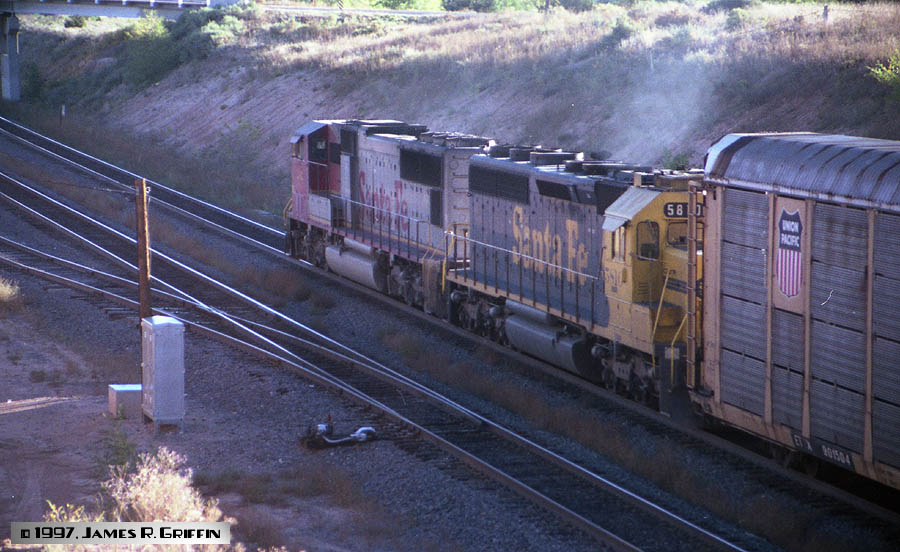 |
The same train, going away. How these two shadowy photos turned out so well is beyond me! I really like the SD45-2s. This one was repainted in BNSF H1 paint the following year. |
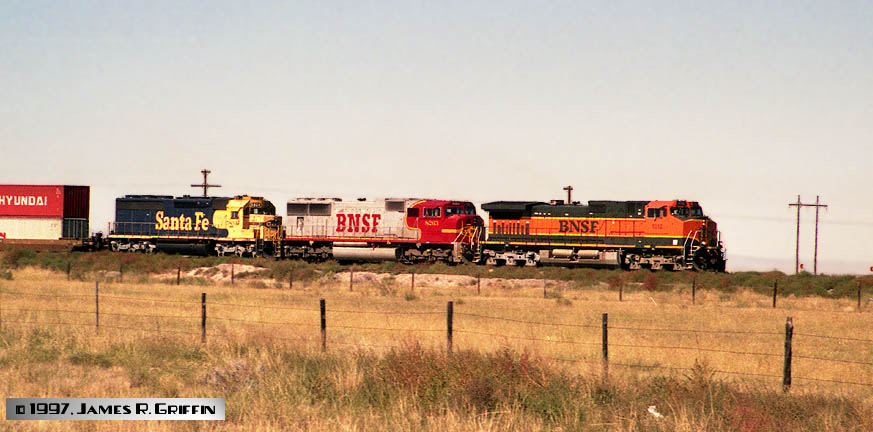 |
This eastbound stack train at Sais could serve as a metaphor for the entire merger process, if you read from left to right |
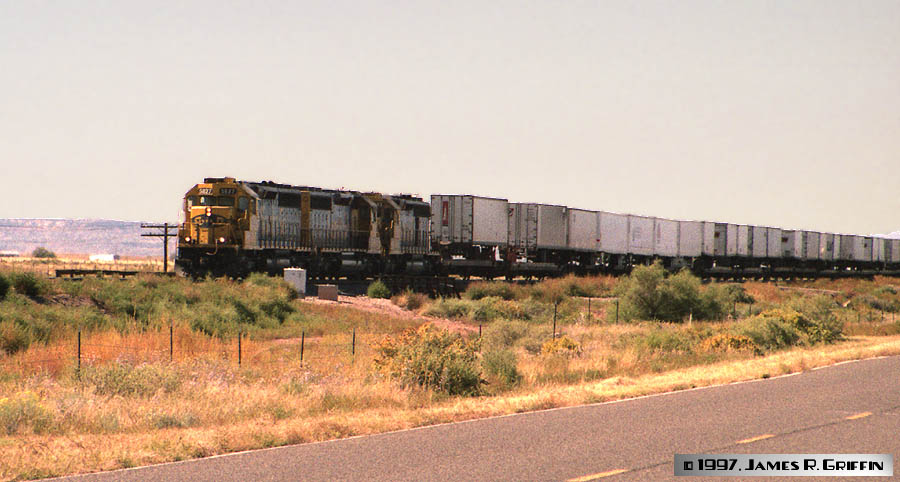 |
Following right behind was this pig train with a solid set of AT&SF SD45-2s– all in blue-and-yellow, no less. This was getting less common, and would be very rare within a couple of years. |
See the BNSF section for additional Warbonnet views, and stay tuned as I resurrect additional posts with Santa Fe alumni.

 Action Road
I’m painting the Blue Bonnet on an A/B set F-1 Engines, to go with the 2 A/B sets of Red Bonnet F-7s I have now. I’m getting a GE Dash-8 40CW in the Red Bonnet too. The F-1s used to be in the FRISCO Livery of all black w/ 2 yellow stripes down the side & green on hood in front of windshield. I have a ATSF Layout, desert scheme of a small town for the MoW yard w/ 2 wrecking cranes, one repainted from UP colors, to Black & Silver ATSF MoW colors, Silver body & Black roofs.
LikeLike